

Galapagos Species Database
The Galapagos Species Database shares the information about the species from our Natural History Collections.
Aristolochia odoratissima
holandés fragantes de tubería, zaragoza, bejuco de zaragoza, fragrant dutchman's pipe, duck, swan
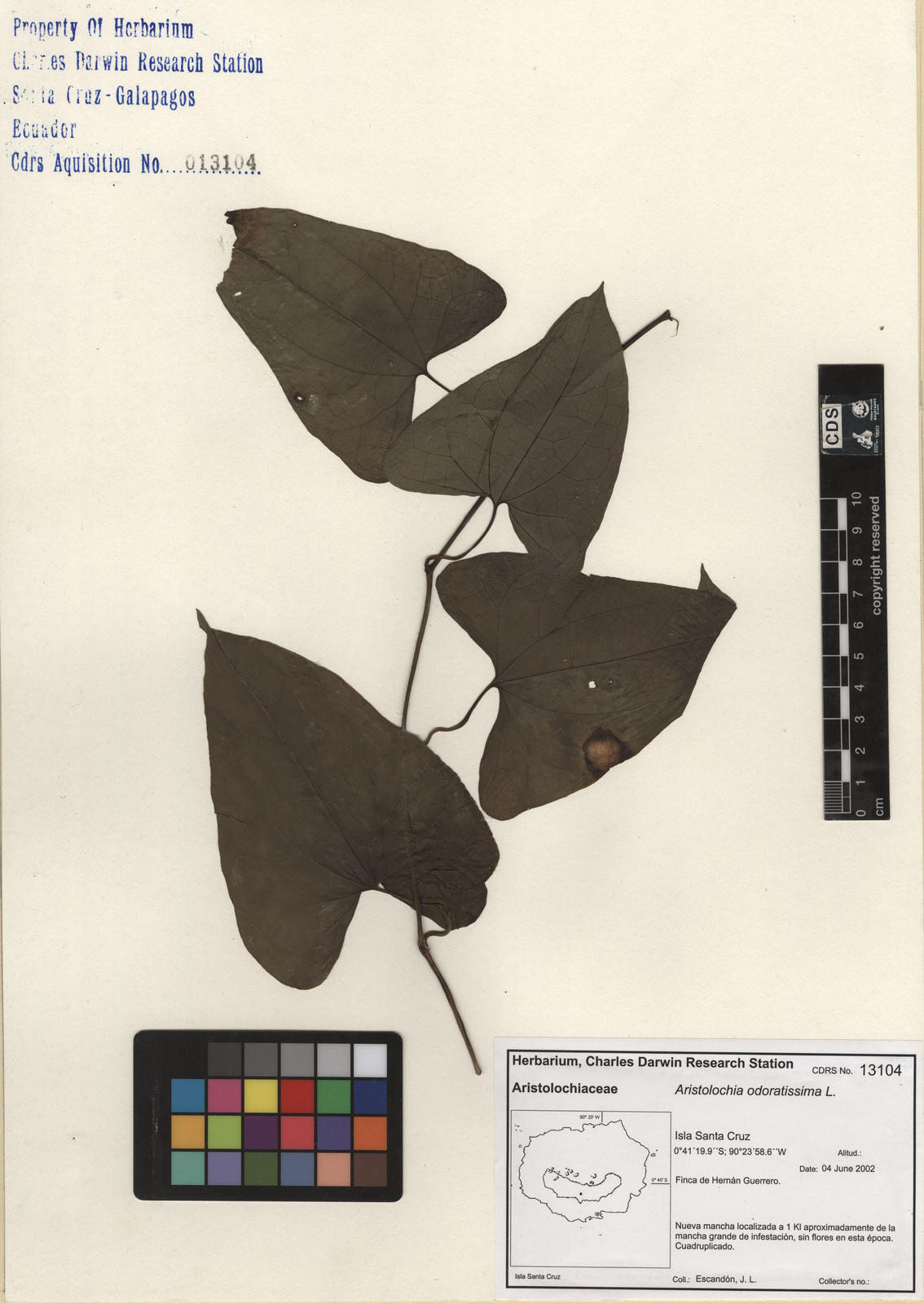
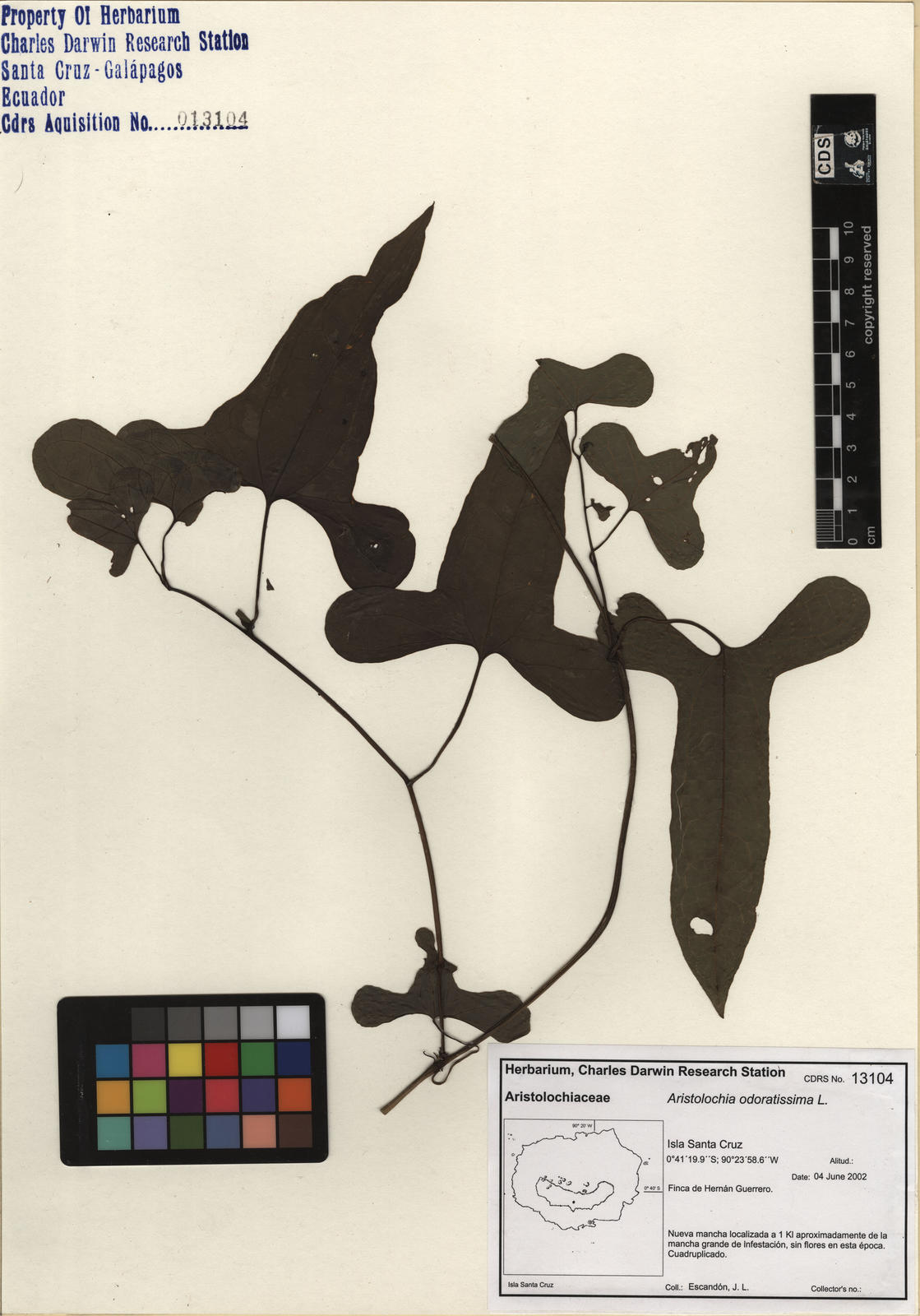
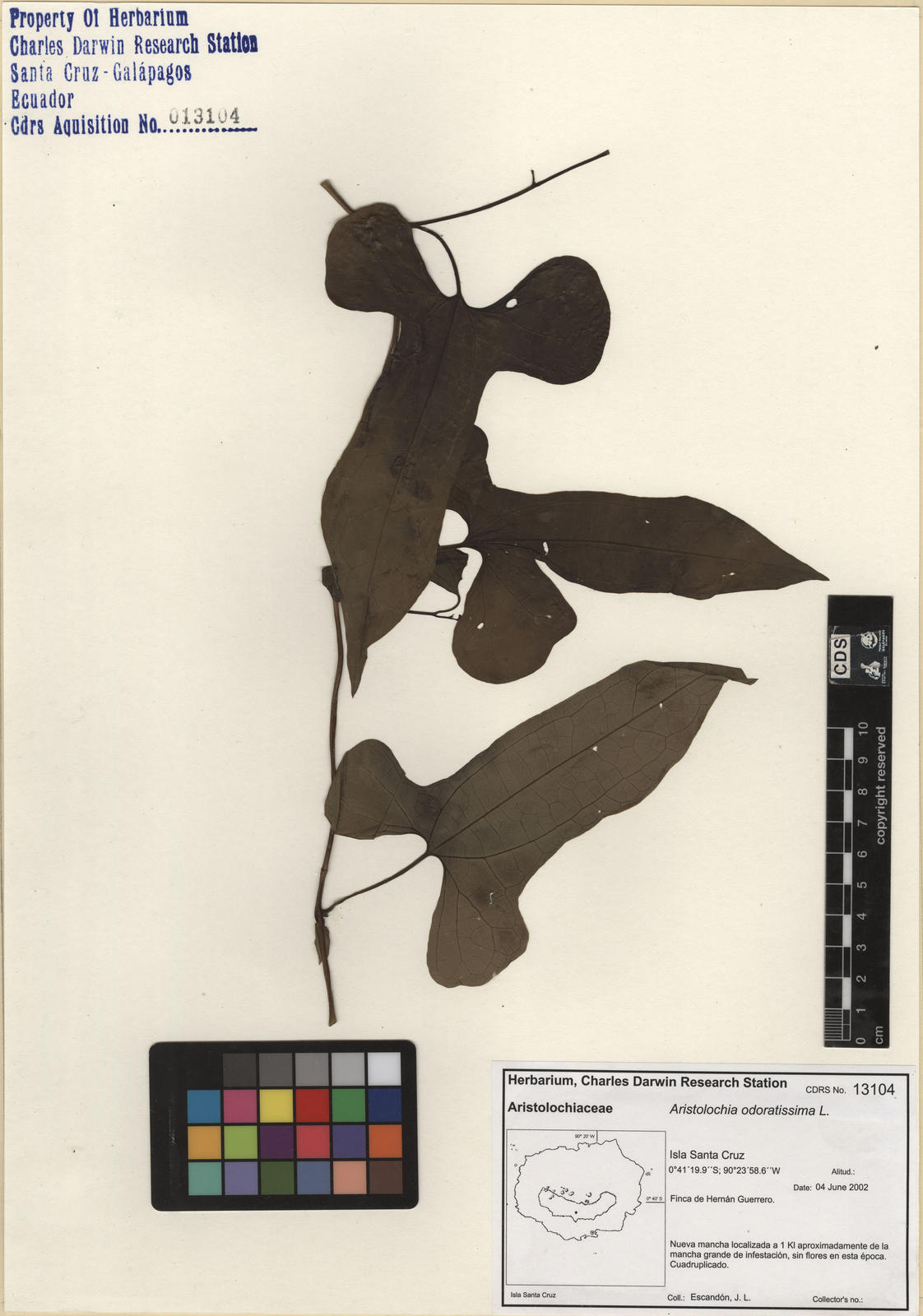
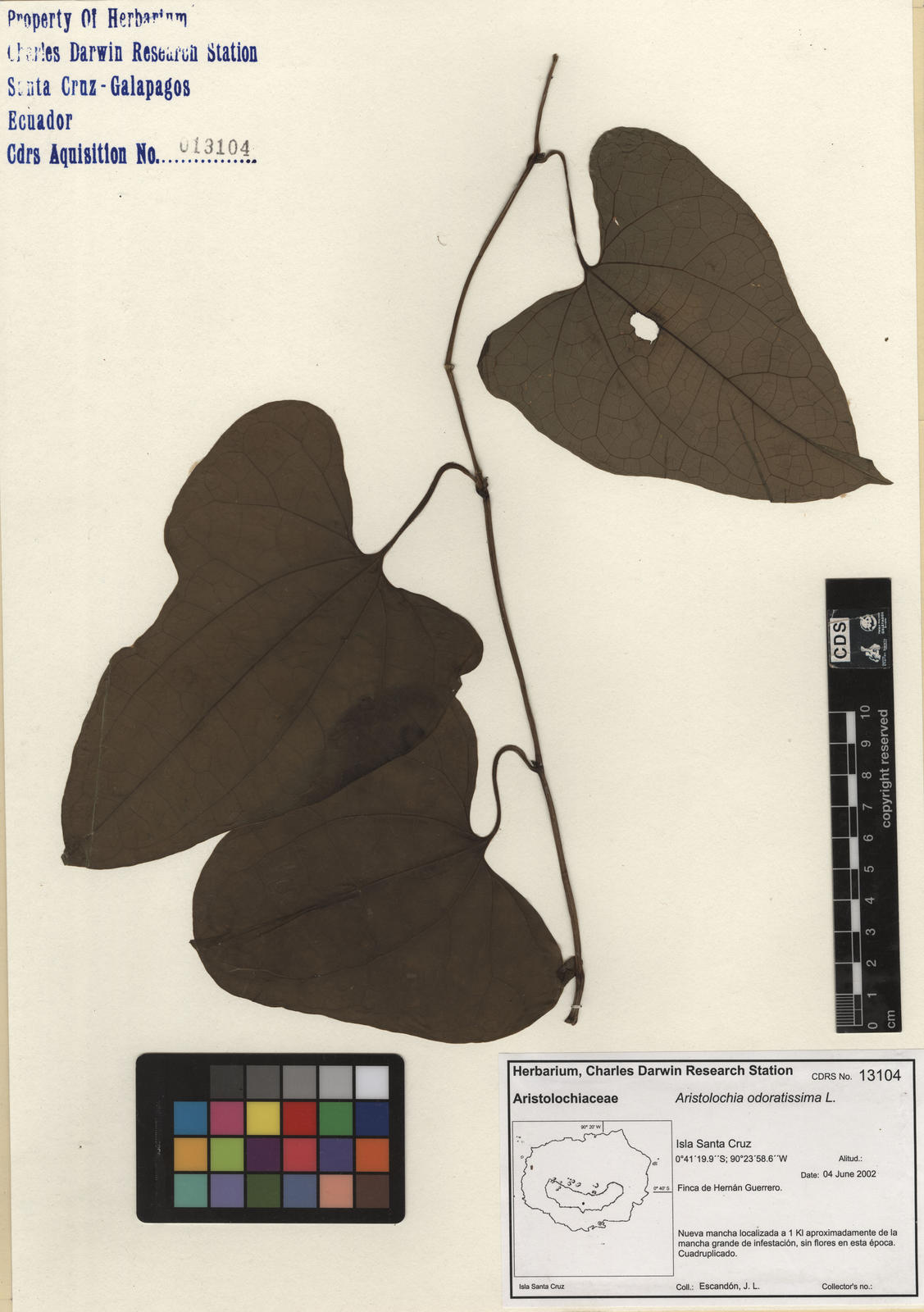
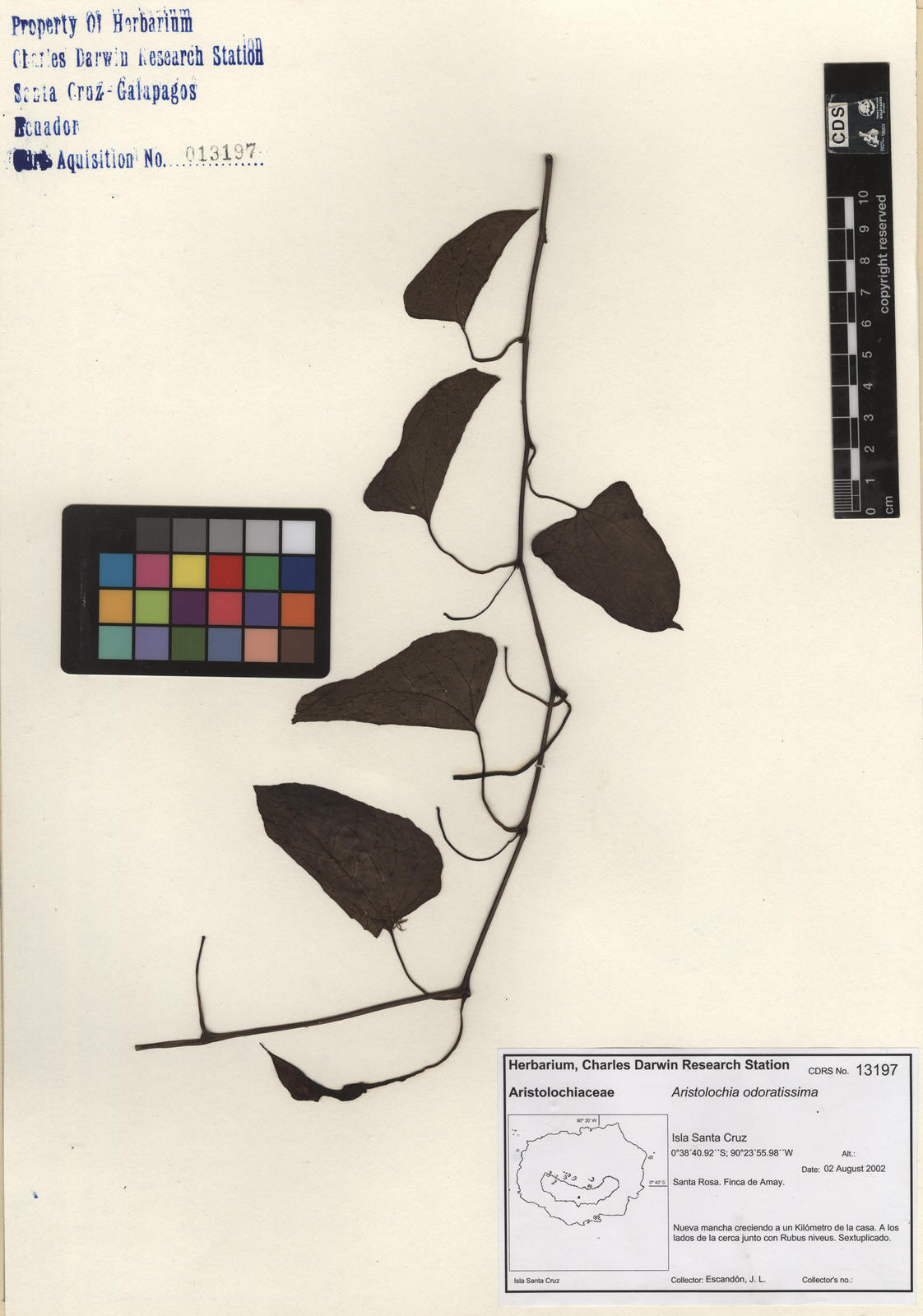
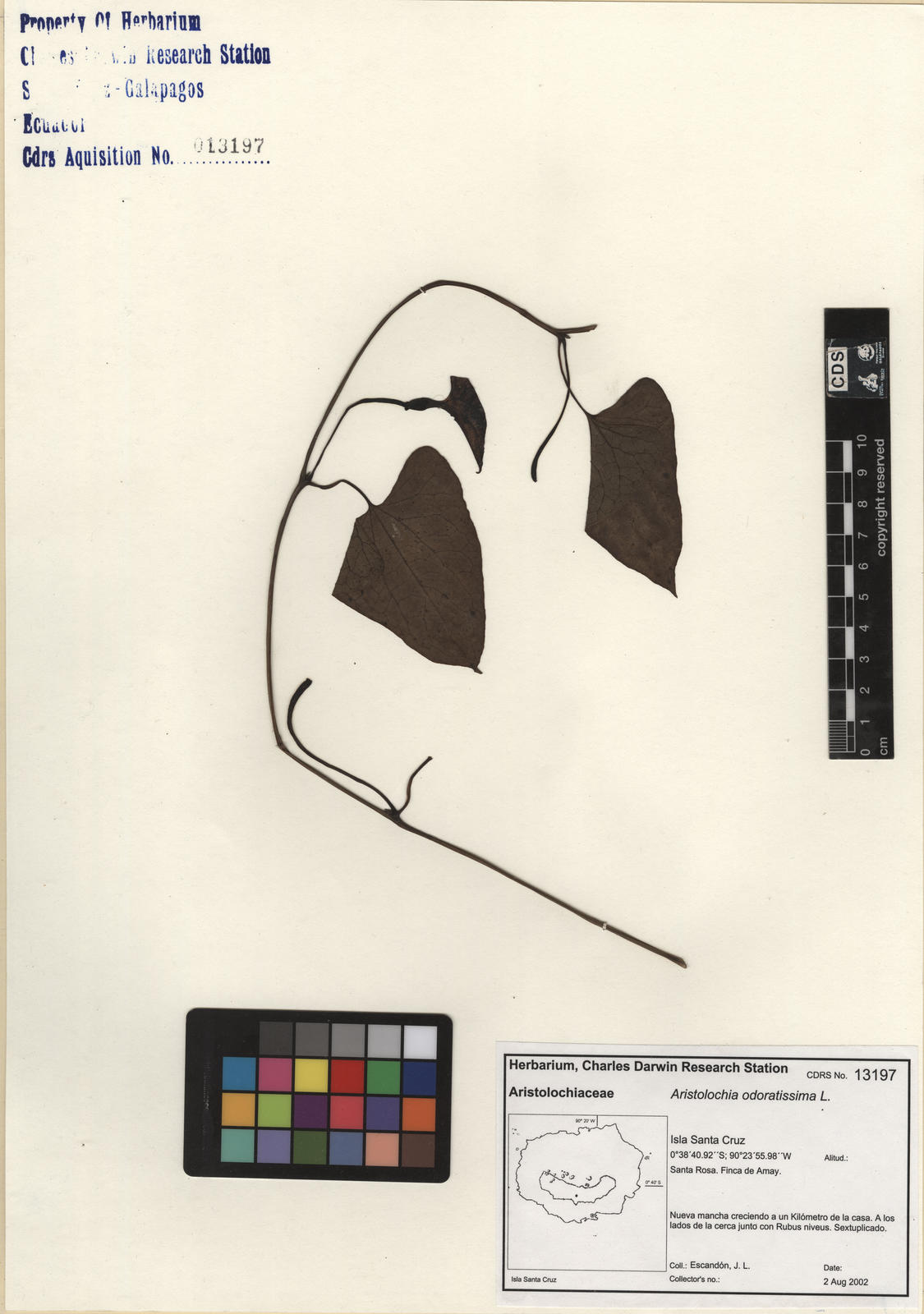
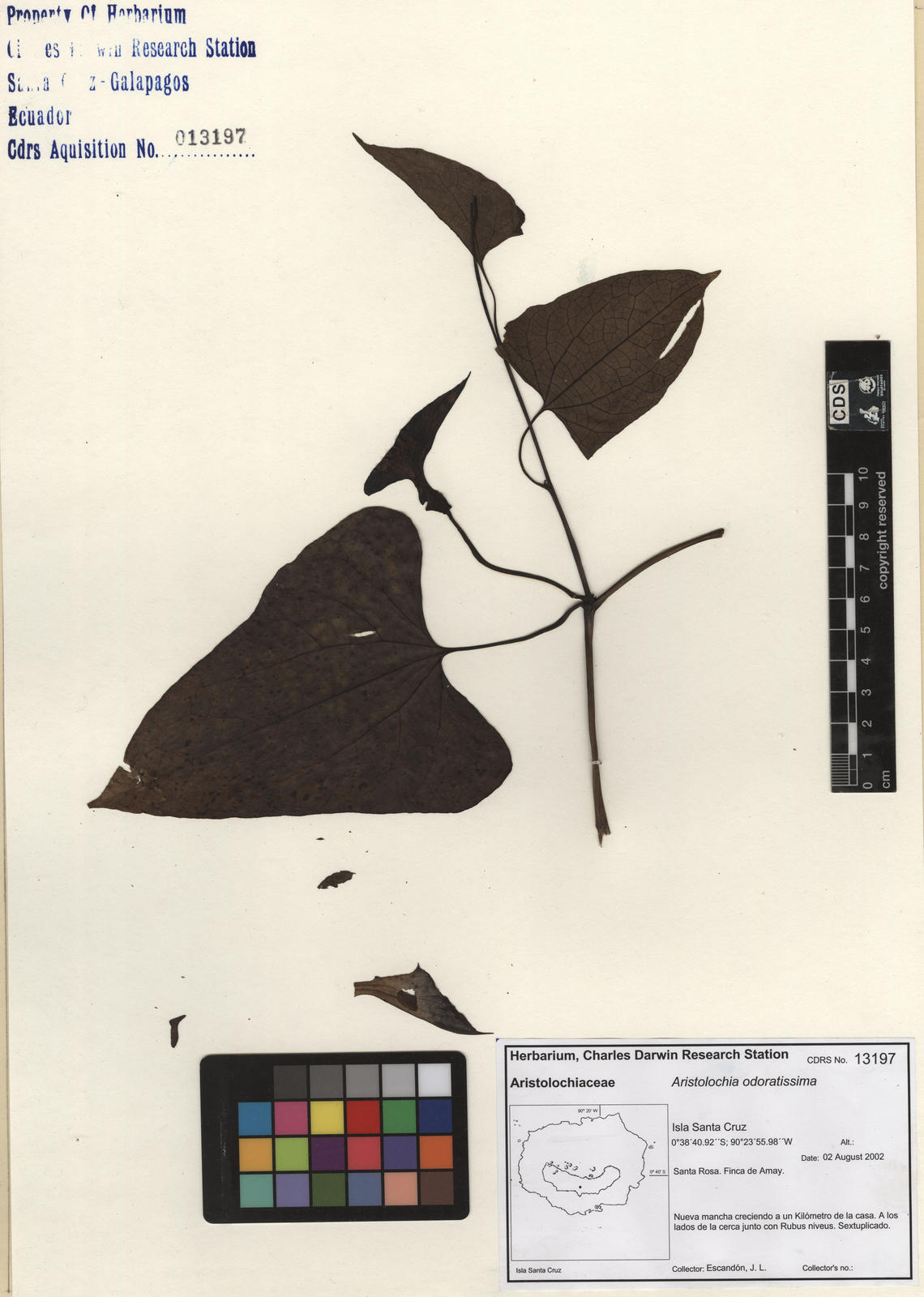
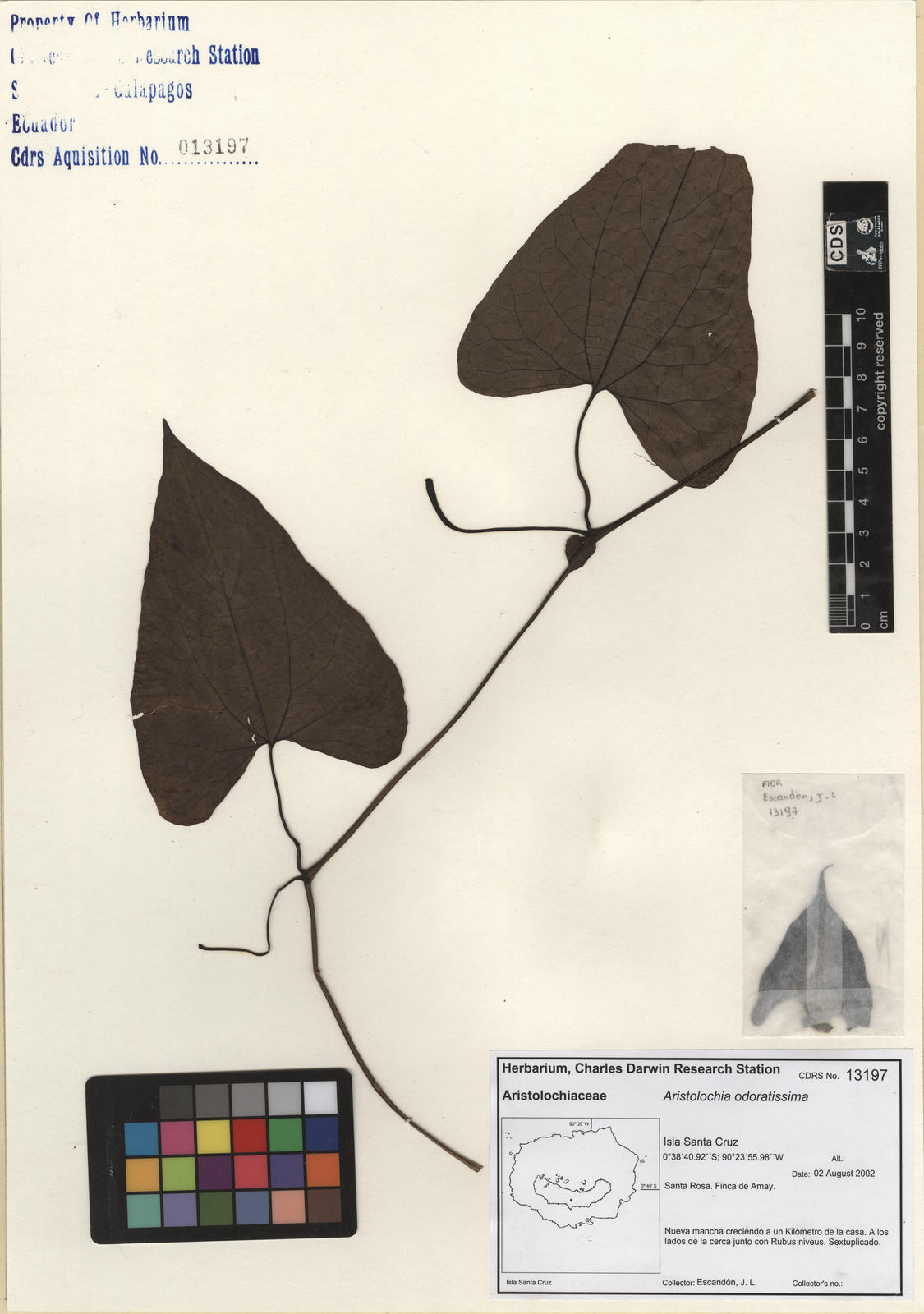
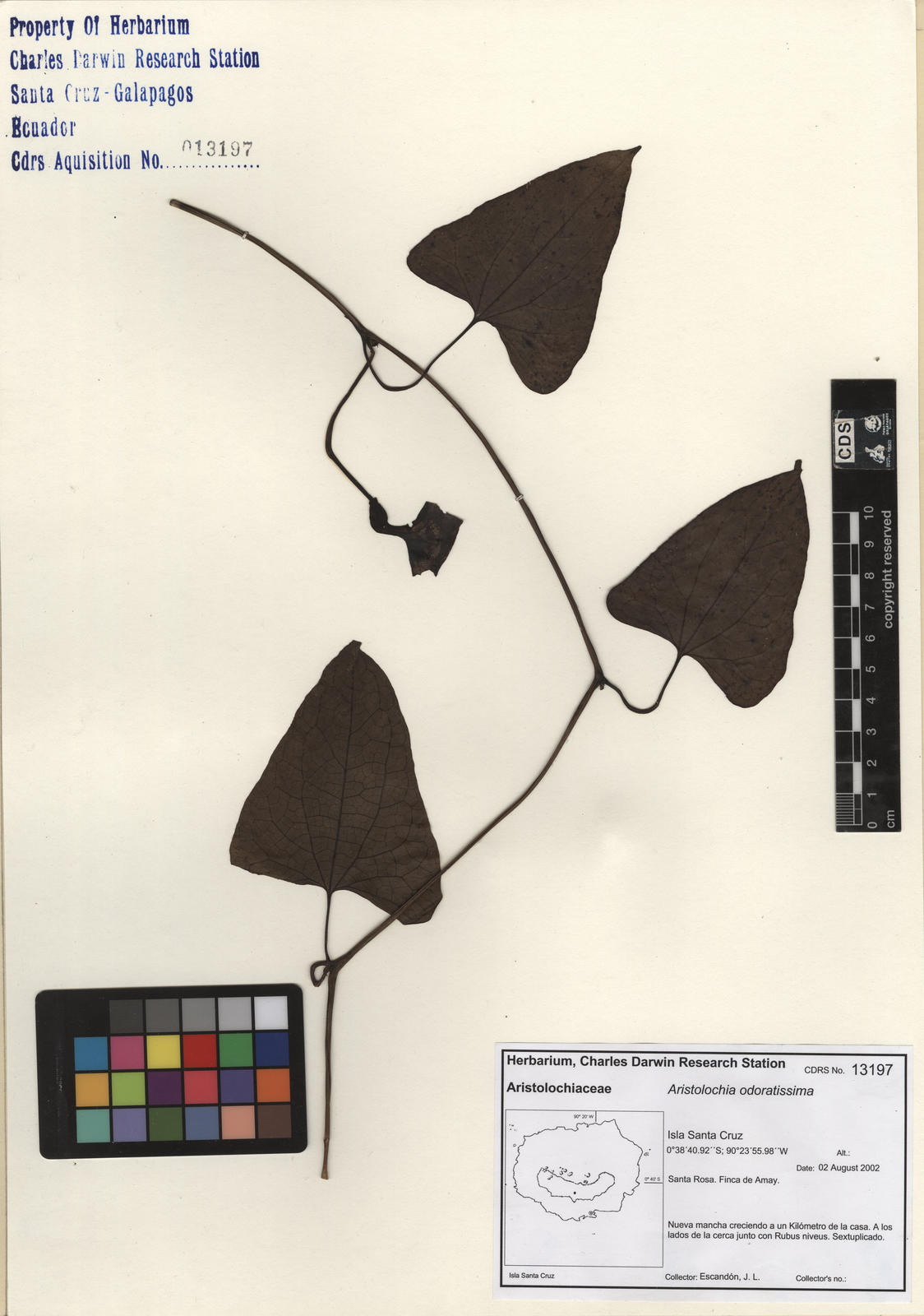
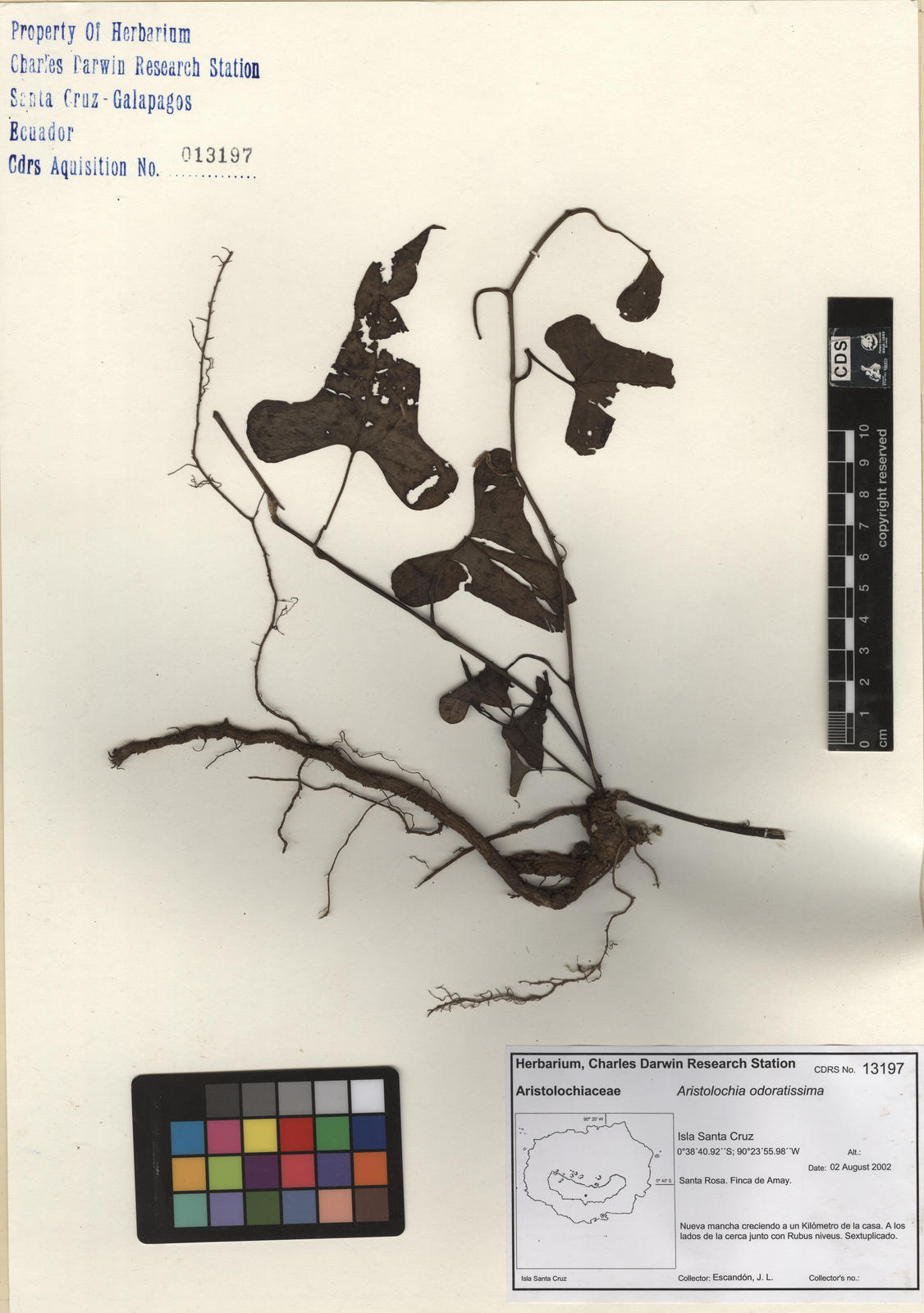
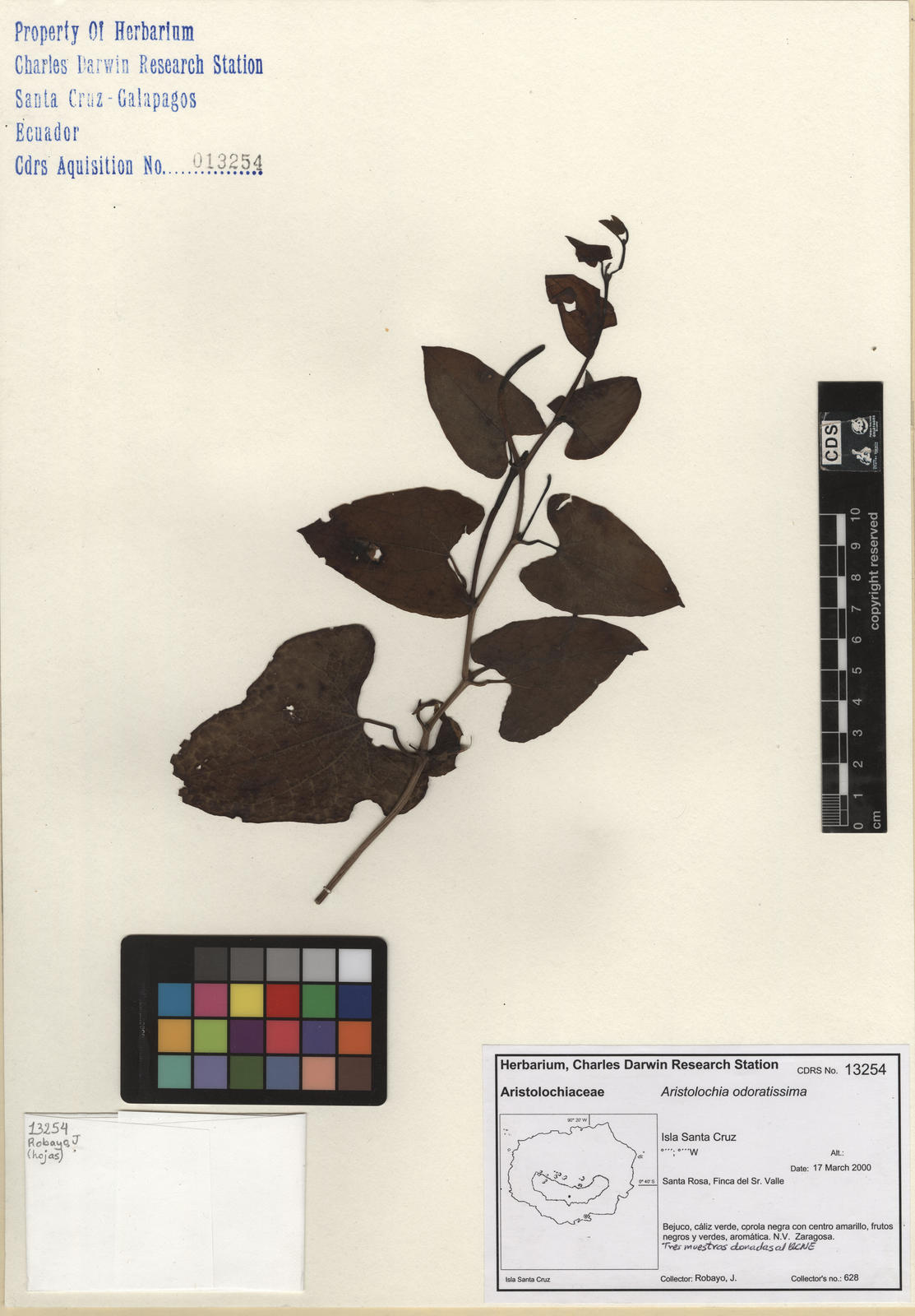
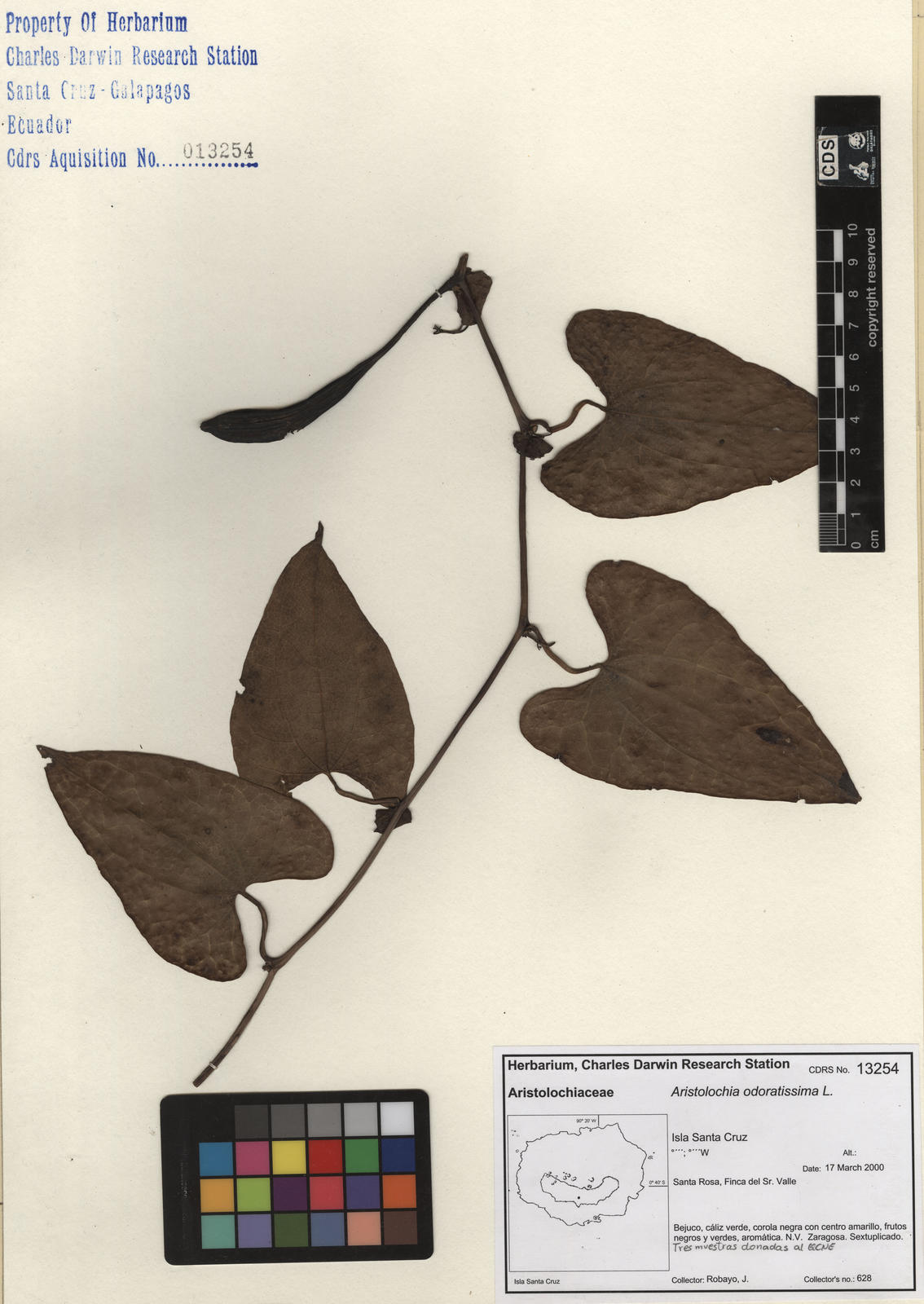
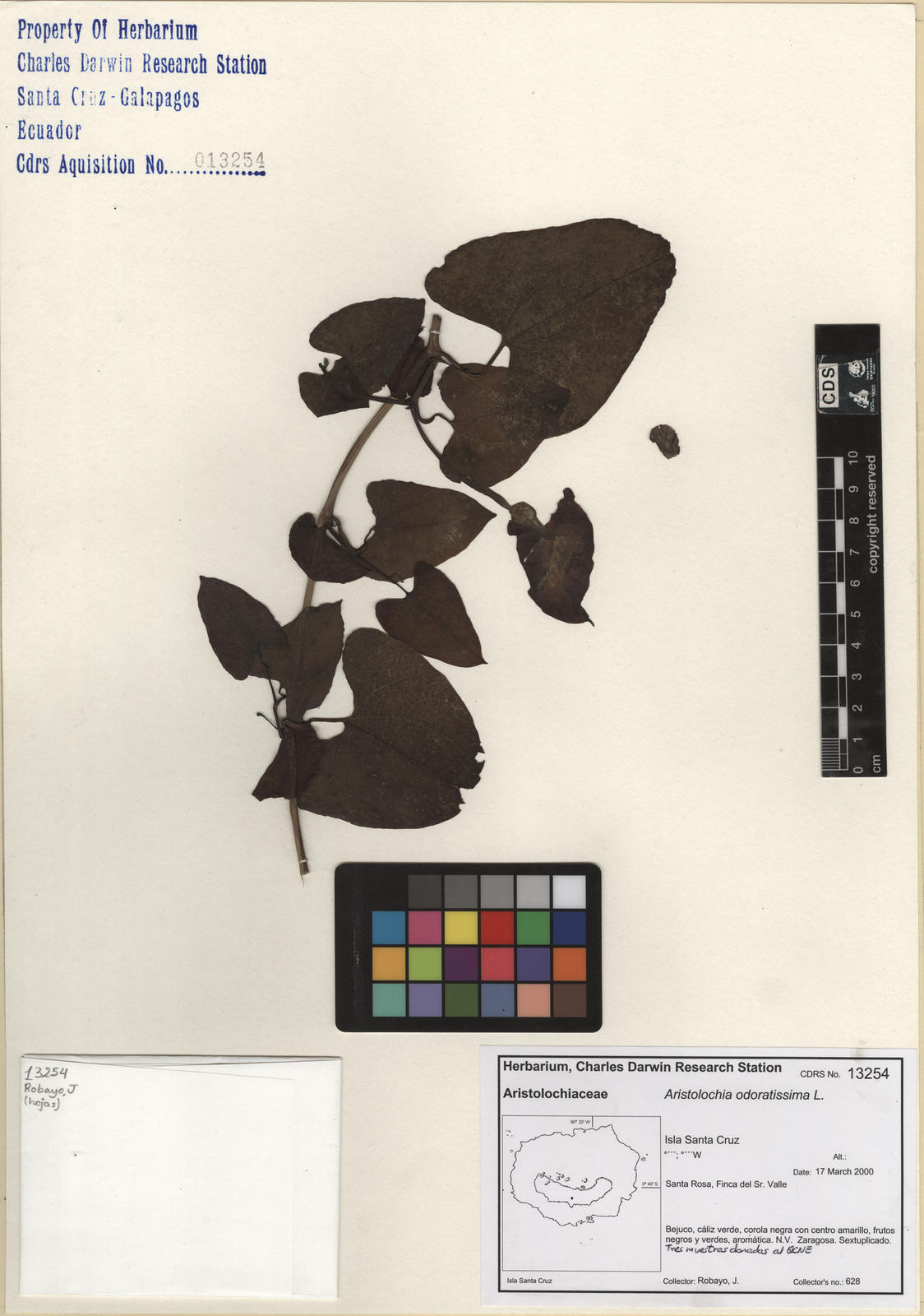
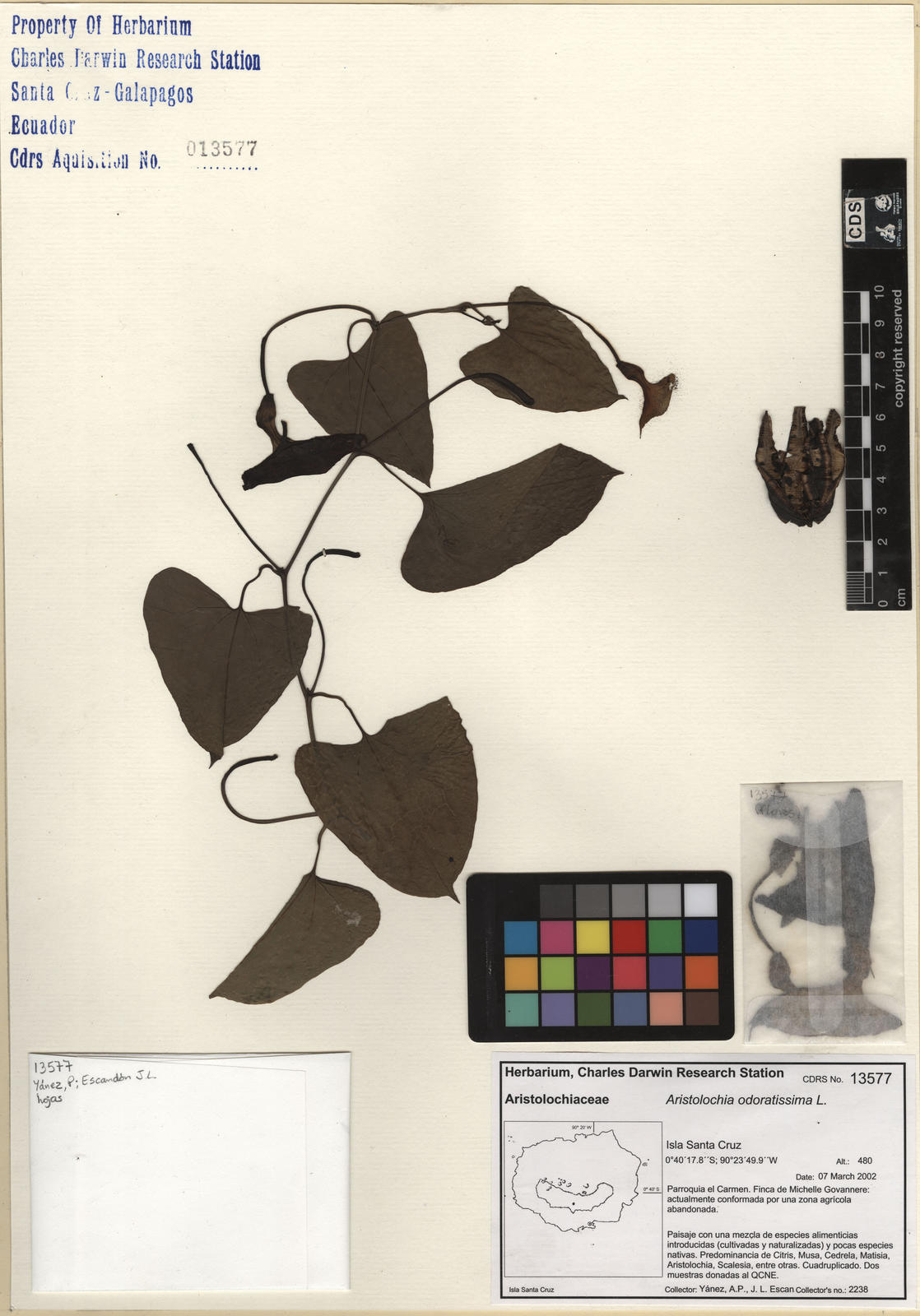
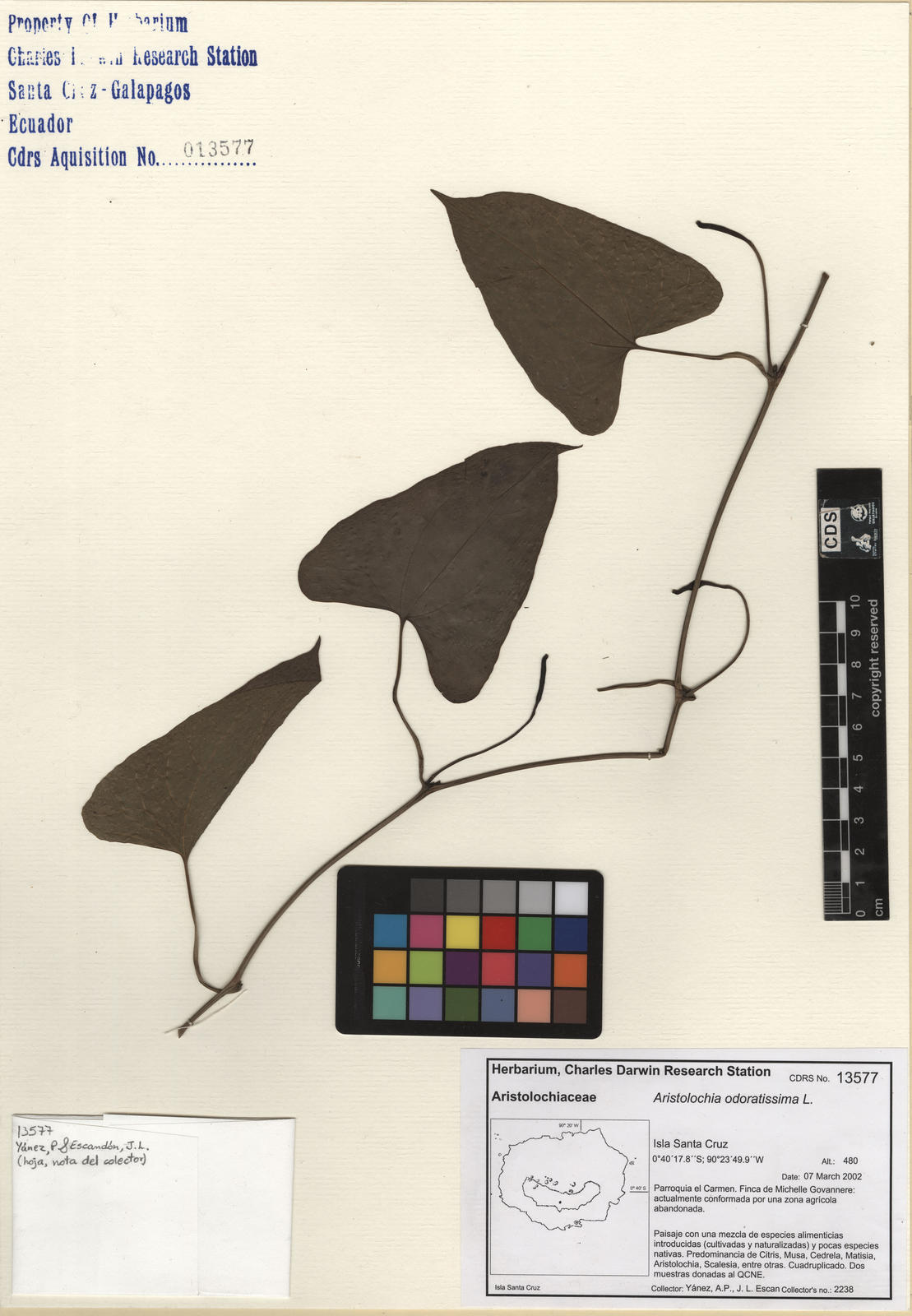
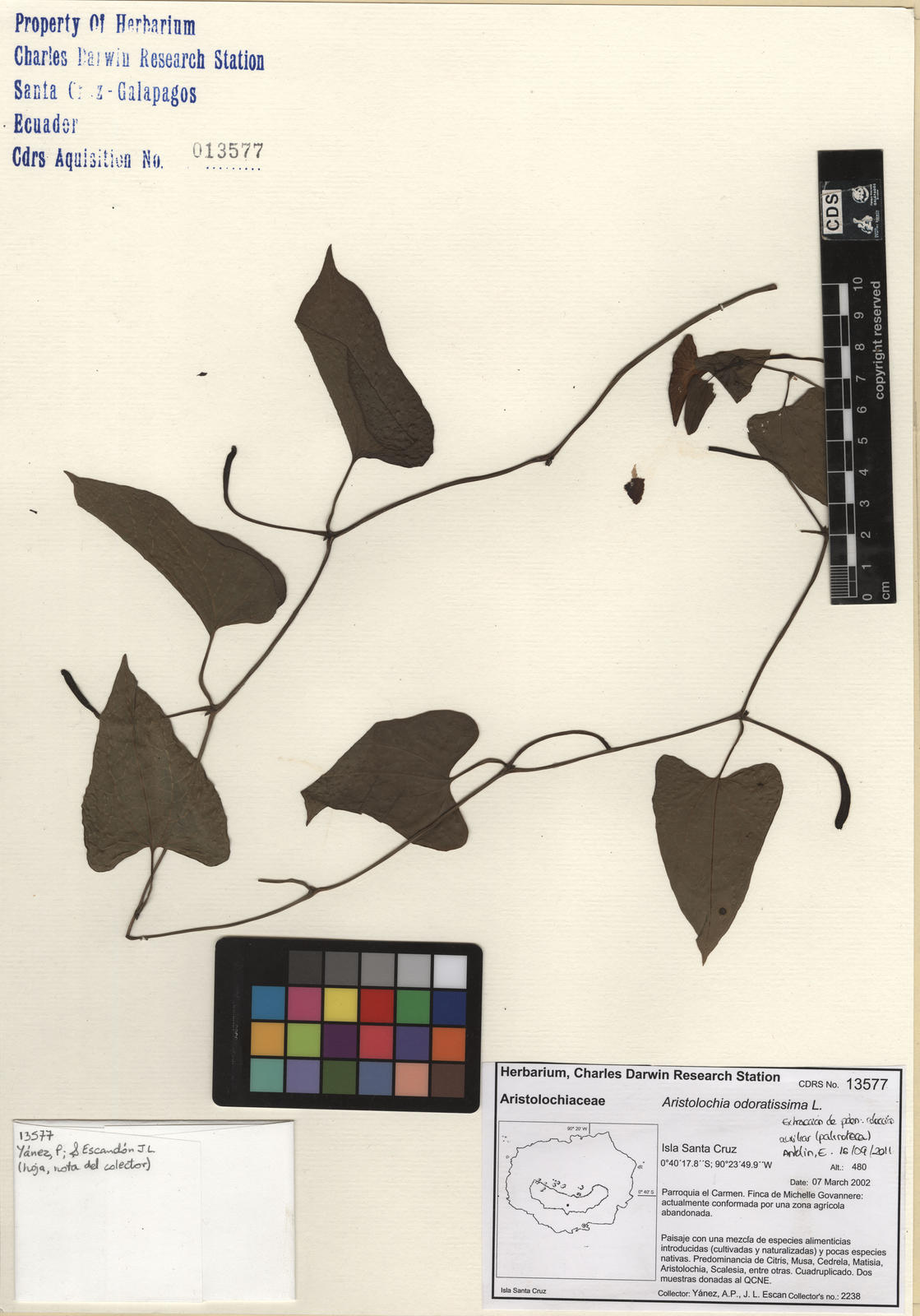
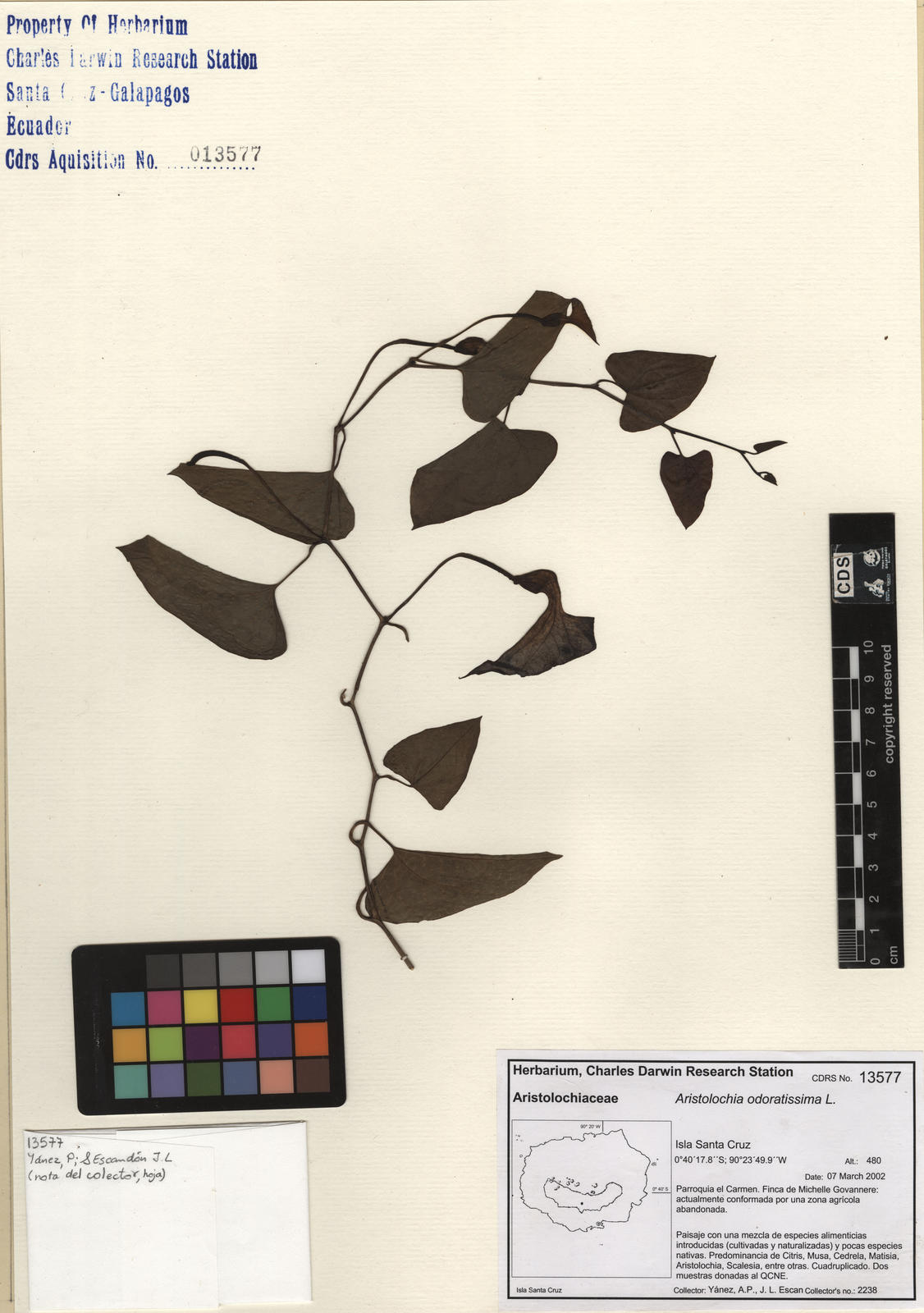
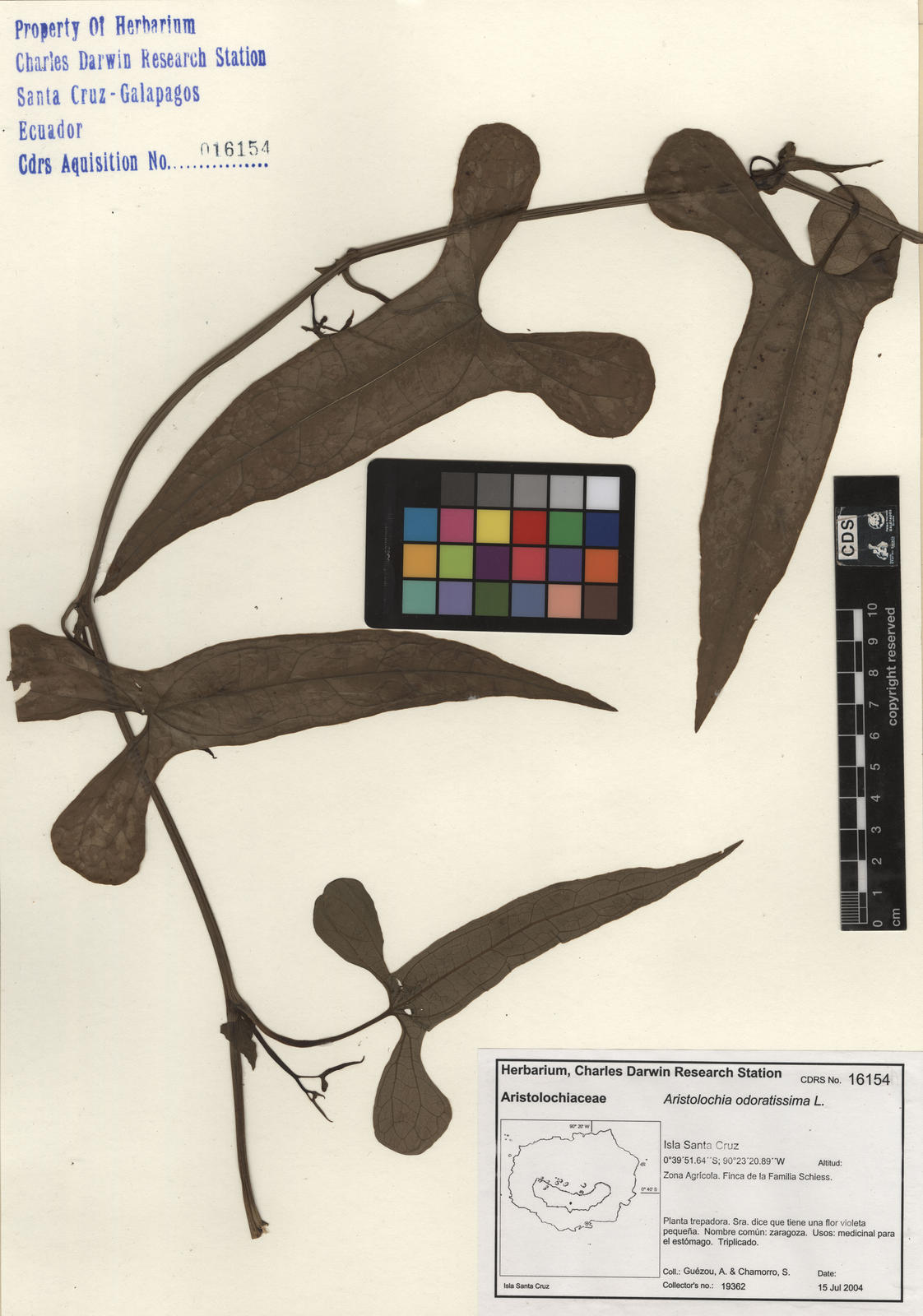
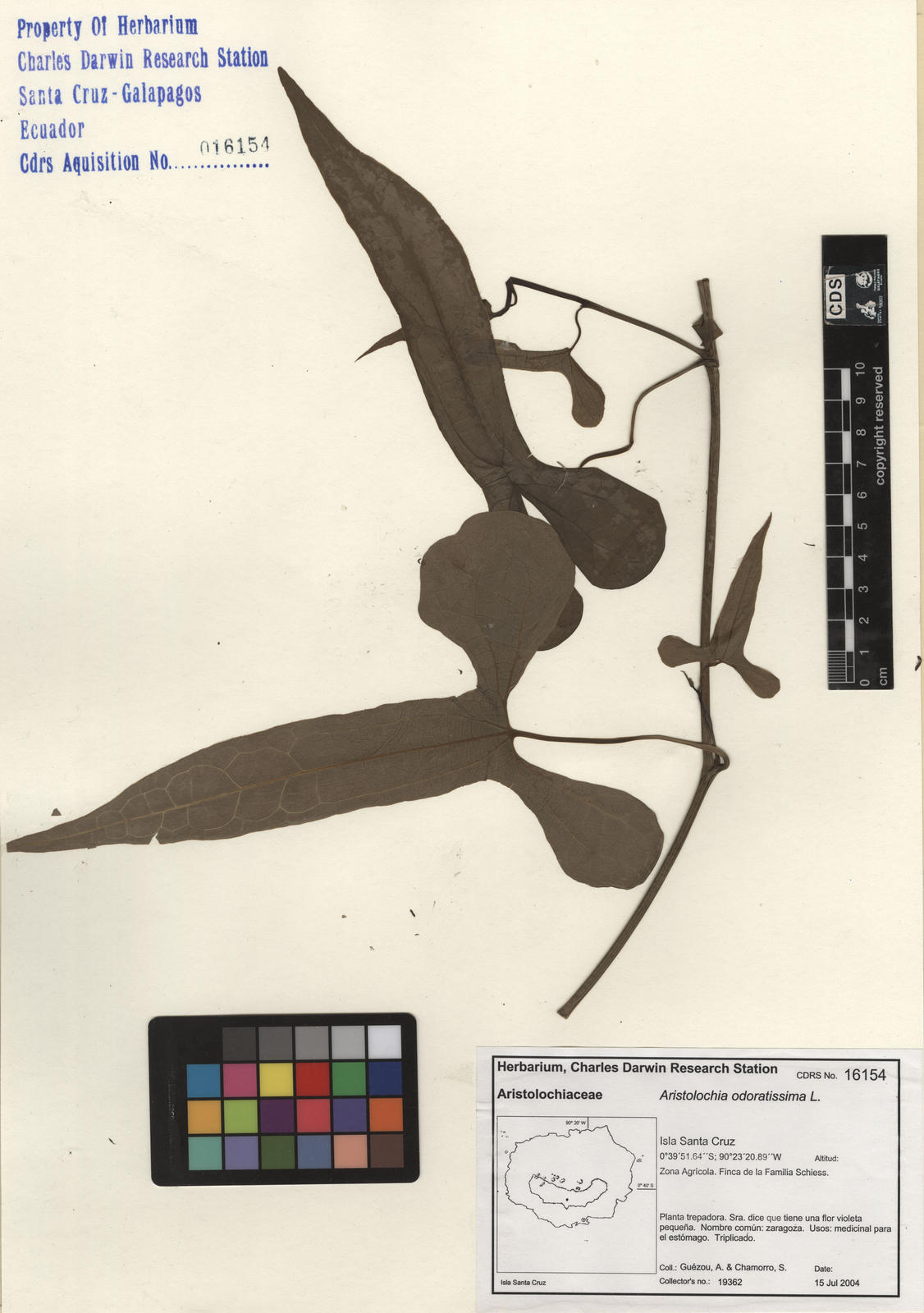
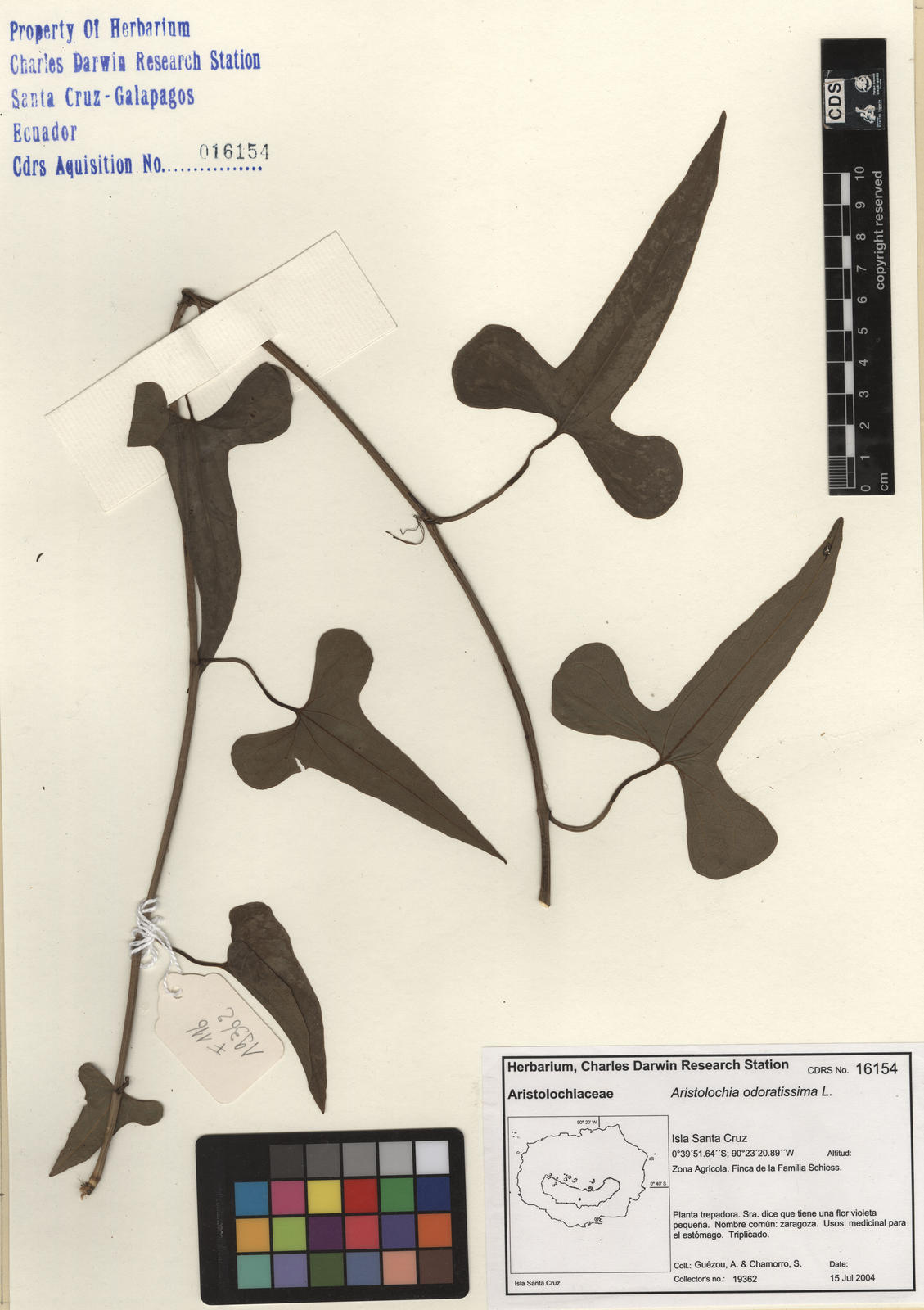
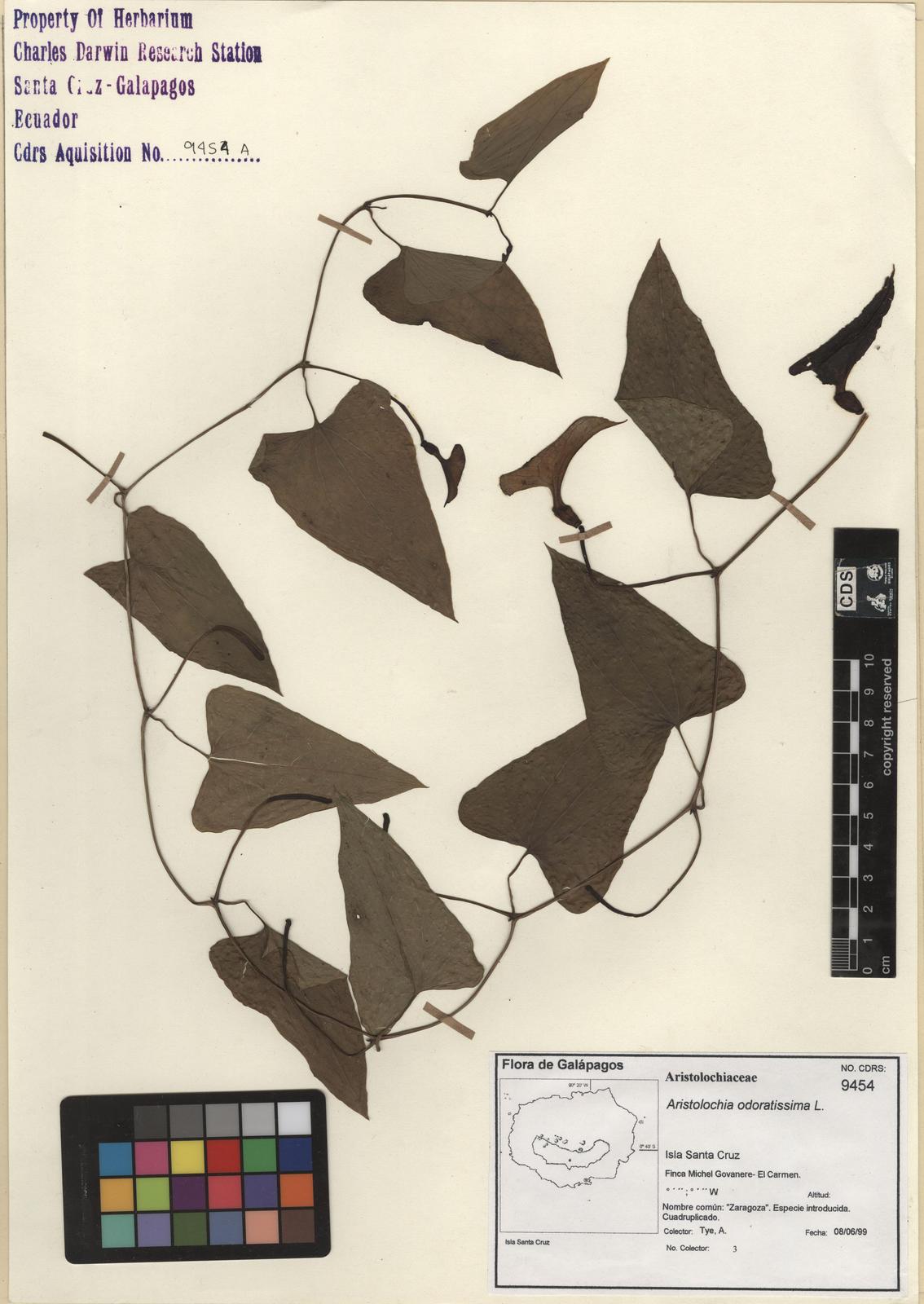
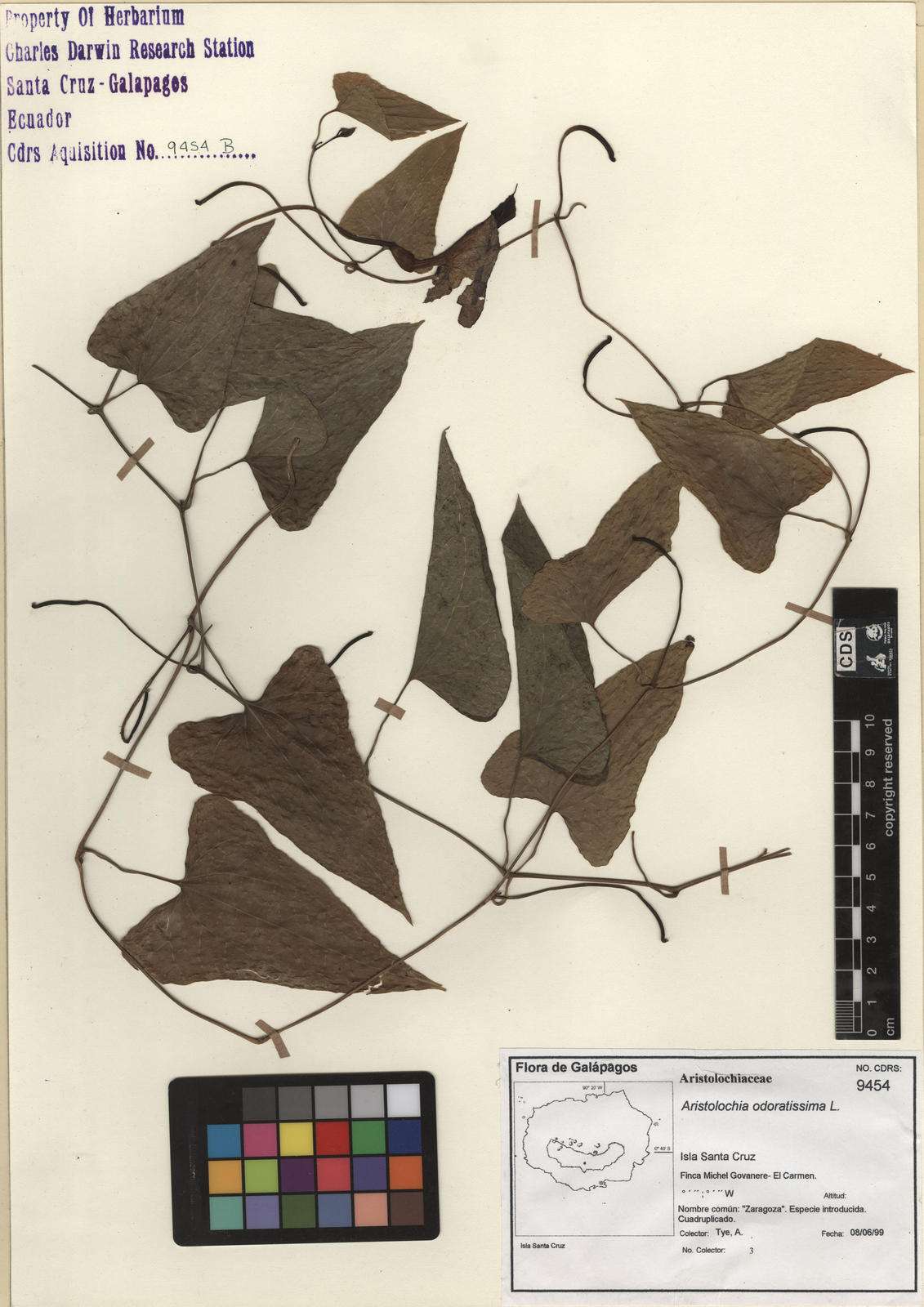
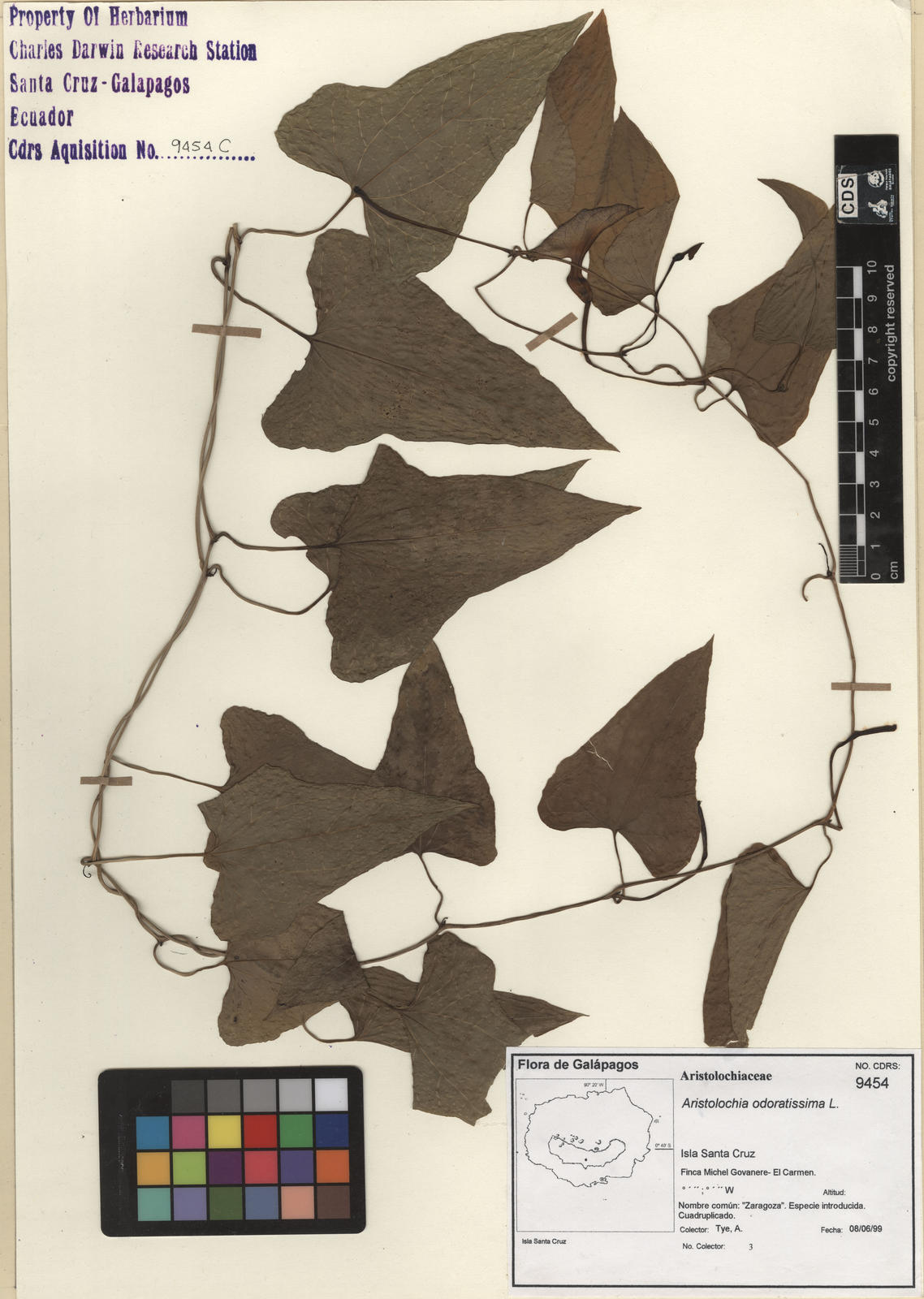
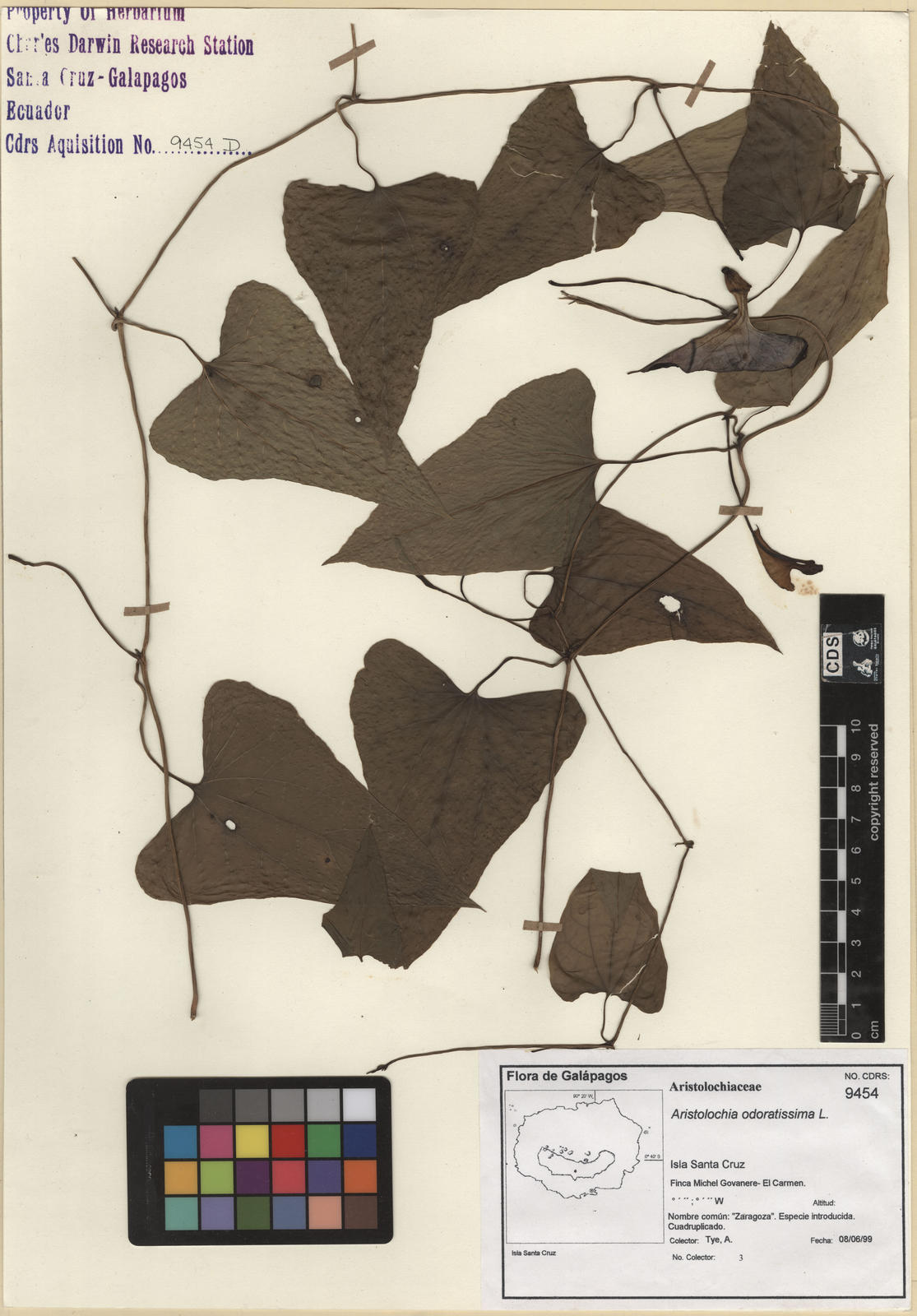
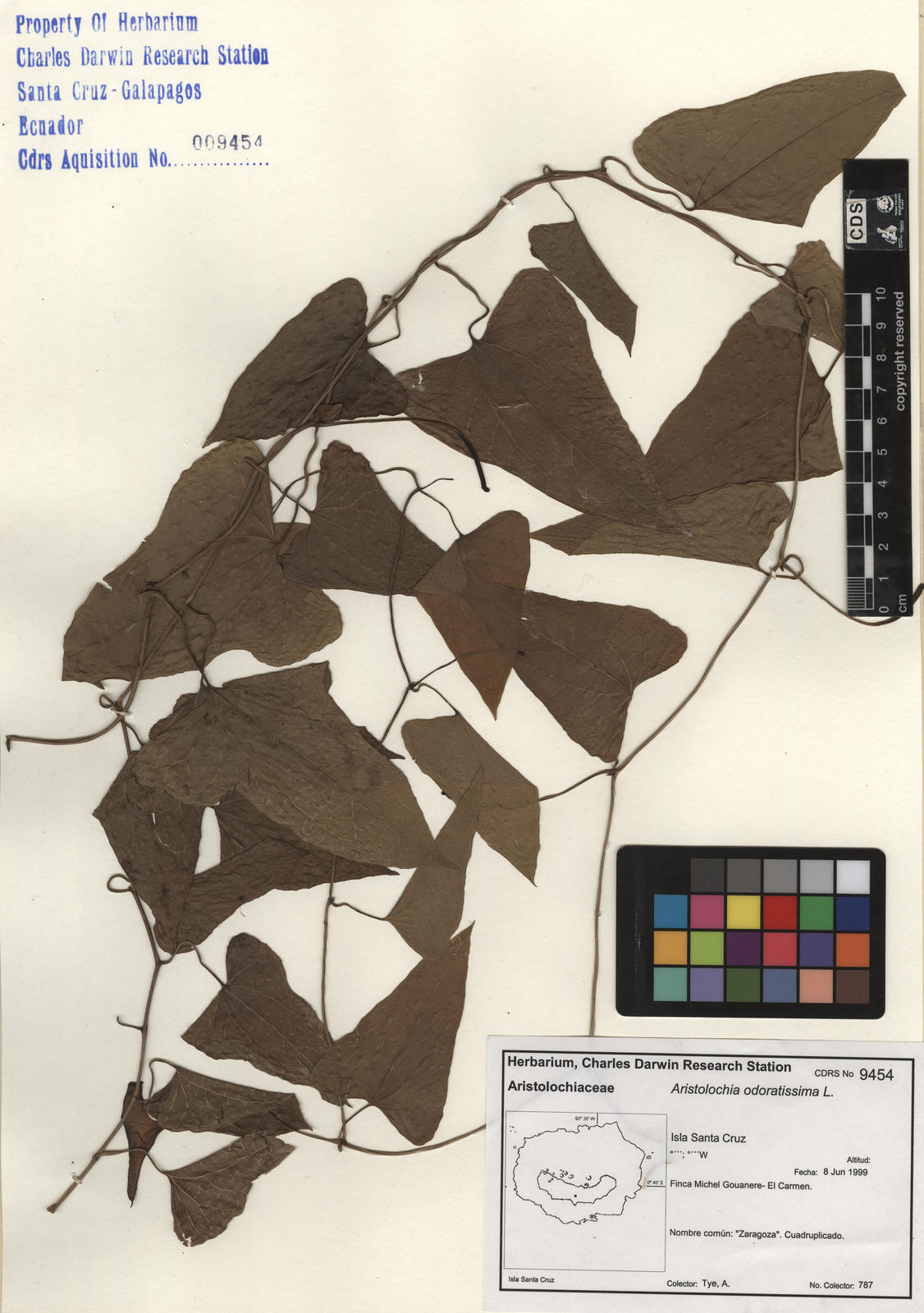
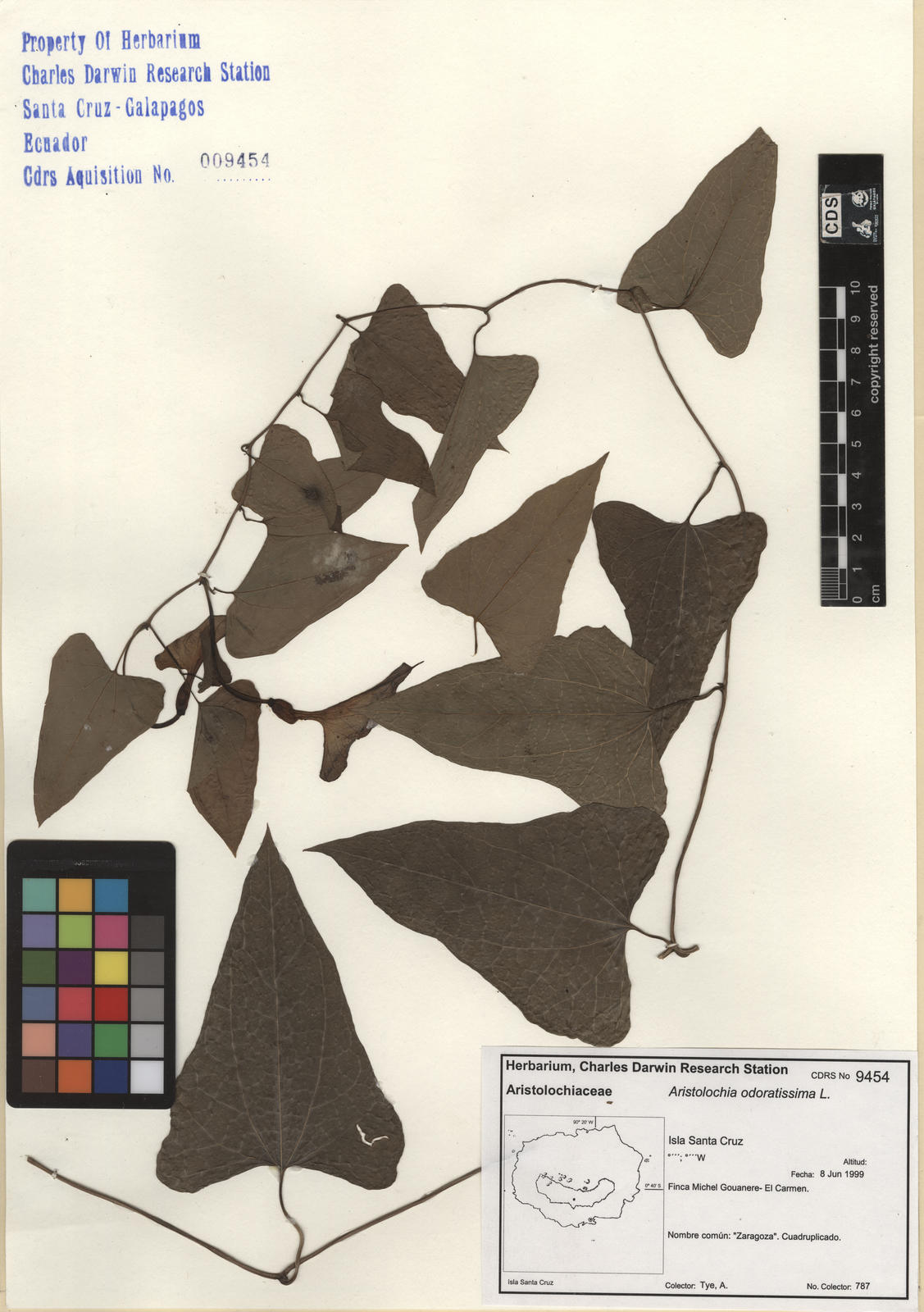
A herbaceous plant that forms a climbing woody vine. Leaves are heart-shaped, and the flowers are purple and pitcher-shaped with a yellow center.
A herbaceous plant that forms a climbing woody vine. The leaves are heart-shaped, and the beautiful purple flowers are pitcher-shaped with a yellow center. This species can reproduce by seed or from small fragments of root. The fruits contain hundreds of small seeds.
Domain
Eukaryota
Kingdom
Plantae
Phylum
Magnoliophyta
Class
Magnoliopsida (= Dicotyledoneae)
Order
Aristolochiales
Family
Aristolochiaceae
Genus
Aristolochia
Species
odoratissima
Taxon category: Accepted
Syn.: Aristolochia pandurata Jacq. and Aristolochia rimbachii O.C. Schmidt
Origin: Introduced - established
Year of first record: 1985
Mode of introduction: Intentional
Introduction Pathway: Intentional
Subpathway: Agriculture/Horticulture
Introduced status: Naturalized
Invasive status: Invasive
Impact in Galapagos: The area it was introduced in is thickly covered in vegetation. It produces very few seeds that do not seem to be viable, and can only disperse short distances with root fragments.
Impact elsewhere: The ability to reproduce from small root fragments, its rapid growth and shade tolerance allows A. odoratissima to form a dense layer on the ground. This species has not been reported as an invasive species in other sites but the closely related species A. elegans is very invasive on many islands.
Control methods elsewhere: The seedlings should be pulled manually. For juveniles and adults the stems need to be cut and herbicide (picloram) needs to be applied to the cut stem as well as new shoots to kill the roots.
Preference for an altitude zone in Galapagos: Humid zone
Trophic role: Primary producer
Persistence mechanisms: Seeds
Reproductive biology: Reproduces via seed production and via root fragments. The fruits contain hundreds of seeds.
Growth form: Crustose
Distribution origin: Central and South America
Map of specimen collection localities or observation records for this species in our collections database.
Distribution: Infestation of 40 ha located on a farm in the highlands of Santa Cruz, originally from Central and South America.
- Brako, L. Zarucchi,J.L. (1993) Catalogue of the Flowering Plants and Gymnosperms of Peru. Monogr. Syst. Bot. Missouri Bot. Gard. 45: i–xl, 1–1286.
- Flores, E. (1985) Censo de Plantas Introducidas desde el Canal de Itabaca hasta Puerto Ayora. Tesis de Ingeniero Forestal, Univ. Técnica Luis Vargas Torres, Esmeraldas: 1-132.
- Guézou, A. Trueman, M., Buddenhagen, E., Chamorro, S., Guerrero, A.M., Pozo, P., Atkinson, R. (2010) An extensive Alien Plan Inventory from the Inhabited Areas of Galapagos Plos One/ www.plosone.org. Volume 5/ Issue 4/e10276
- Hokche, O. Berry, P.E. & Huber, O. (2008) Nuev. Cat. Fl. Vas. Venezuela 1–860.
- Jørgensen, P.M. Nee, M. & Beck, S. G. (2010) Catálogo de las plantas vasculares de Bolivia. Monogr. Syst. Bot. Missouri Bot. Gard.
- Jørgensen, P.M. León-Yánez, S. (eds.) (1999) Catalogue of the Vascular Plants of Ecuador. Monographs in Systematic Botany from the Missouri Botanical Garden 75. Missouri Botanical Garden Press, St. Louis, 1181 pp.
- Tropicos.org. (2017) Database of Missouri Botanical Garden. Tropicos.org. Missouri Botanical Garden. 06 Oct 2017 <http://www.tropicos.org
You are welcome to download and use the information found in this page, acknowledging its source.
This page should be cited as follows:
"Galapagos Species Database, Aristolochia odoratissima", dataZone. Charles Darwin Foundation, https://datazone.darwinfoundation.org/en/checklist/?species=1413. Accessed 6 November 2026.
Dispersal propagule: Varius
Disperses with seeds or vegetatively via root fragments.