

Galapagos Species Database
The Galapagos Species Database shares the information about the species from our Natural History Collections.
Redonographa galapagoensis
liquen de de escritura de Redón en Galápagos, Redon's script lichen of Galapagos
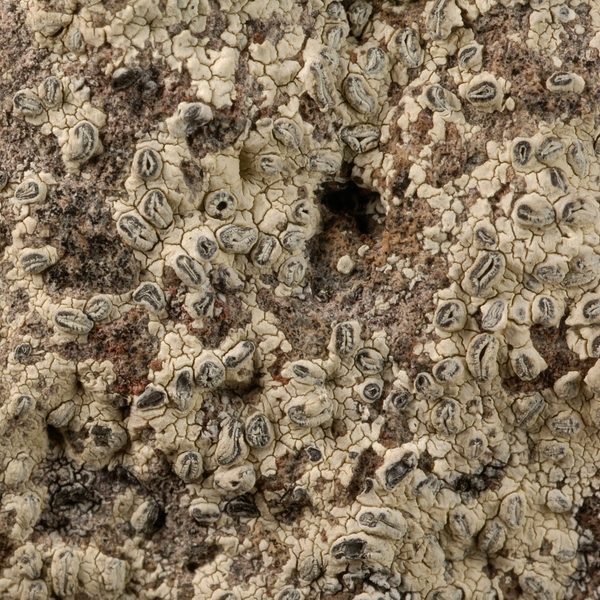
Thallus areolate, whitish gray, becoming yellowish-white in the herbarium; surface smooth, epruinose. Apothecia prominent, rounded to shortly lirellate; lirellae broad and short, thickened, unbranched or rarely sparsely branched; labia thick, entire, black, basally with thalline margin, apically and along rim with distinct pruina formed by layer of periphysoids; disc usually concealed but expanding with age; excipulum completely carbonized, carbonization extending below the hymenium; hymenium hyaline, clear (not inspersed), I– (rarely faintly bluish laterally along the excipulum); ascospores 8 per ascus, ellipsoid to oblong, 15–17(–20) × 4–5 μm, submuriform with 5–6 transverse septa and 1–2 longitudinal septa per segment, hyaline, I–. Chemistry: Norstictic acid, thallus K+ yellow turning red (forming needle shaped crystals under the microscope).
The species is recognized by its rather prominent, partially open ascomata, the verrucose periphysoids, and the rather narrow ascospores. The verrucose surface of the periphysoids is different in appearance from the spinulose surface found in Carbacanthographis (Staiger, 2002), suggesting that the two genera are not closely related.
Domain
Eukaryota
Kingdom
Fungi
Phylum
Ascomycota
Class
Lecanoromycetes
Order
Ostropales
Family
Graphidaceae
Genus
Redonographa
Species
galapagoensis
Taxon category: Accepted
Type: ECUADOR. Galapagos: Santiago Island, ca. 5 km inland from the E-coast; 0° 16' S, 90° 37' W; Bungartz 5208 (CDS 29421, holotype); previously reported as Carbacanthographis saxiseda (Bungartz et al., 2010) but was found to represent an undescribed taxon (Lücking et al. 2013).
Origin: Endemic
Map of specimen collection localities or observation records for this species in our collections database.
Distribution: Redonographa galapagoensis appears to be endemic to the Galapagos Islands, growing saxicolous along the coast underneath wind- and rain-sheltered, shaded overhangs.
- Bungartz, F. Lücking, R. & Aptroot, A. (2009) The lichen family Graphidaceae (Ostropales, Lecanoromycetes) in the Galapagos Islands. Nova Hedwigia 90: 1-44.
- Elix, J.A. McCarthy, P.M. (1998) Catalogue of the Lichens of the Smaller Pacific Islands. Bibliotheca Lichenologica 70, J. Cramer, Berlin, Stuttgart, 361pp.
- Lücking, R. Tehler, A. Bungartz, F. & Lumbsch, H.T. (2103) Journey from the West: Did tropical Graphidaceae (lichenized Ascomycota: Ostropales) evolve from a saxicolous ancestor along the American Pacific coast? American Journal of Botany. DOI 10.3732/ajb.1200548
- Weber, W.A. (1993) Additions to the Galápagos and Cocos Islands Lichen and Bryophyte Floras. The Bryologist 96(3): 431-434.
You are welcome to download and use the information found in this page, acknowledging its source.
This page should be cited as follows:
"Galapagos Species Database, Redonographa galapagoensis", dataZone. Charles Darwin Foundation, https://datazone.darwinfoundation.org/en/checklist/?species=17497. Accessed 5 May 2026.