

Galapagos Species Database
The Galapagos Species Database shares the information about the species from our Natural History Collections.
Phaeographis intricans
liquen de escritura, Script lichen
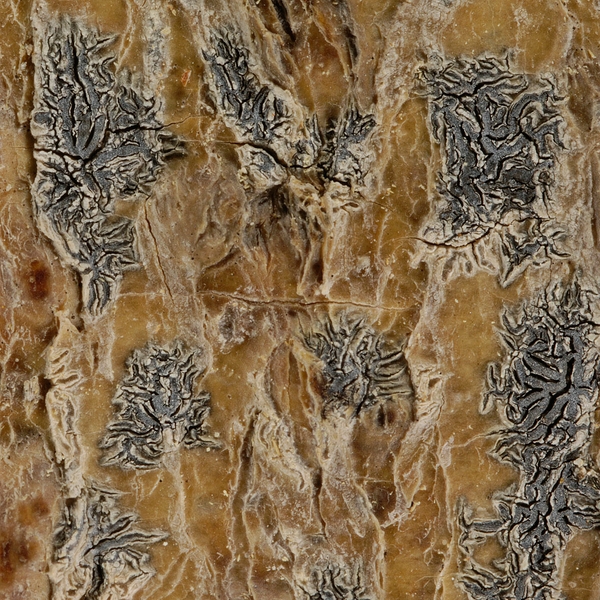
Thallus inconspicuous and almost entirely embedded within its substrate, of the same color or slightly darker, grayish, greenish, or ochraceous; or conspicuous, thin, but distinctly developed on the substrate surface, whitish or grayish; surface smooth, not pruinose; Apothecia immersed to ±prominent, lirellate; lirellae ±narrow, crowded, intricately branched to densely stellate, often embedded into paler pseudostromatic thallus areas; labia thin, narrow or absent, typically with a thalline rim; disc expanded, barely concave to flattened, with a white, farinose pruina; exciple thin, indistinct or laterally almost absent, pale brown to deep yellowish brown, but not carbonized, the basal part often expanding with age (similar to Sarcographa), but not becoming carbonized; hymenium hyaline, clear (not inspers), I–; ascospores pale gray, soon brownish, I+ red or reddish brown, 8 per ascus, oblong to broadly fusiform, 14-27 x 5-7(-8) µm, transversely septate, 4-6 celled. Chemistry: Norstictic and connorstictic acid, K+ orange-red (crystals).
Forms of P. intricans with lirellae densely aggregated into pseudostromatic areas can be superficially extremely similar to Sarcographa tricosa, but their thalli always contain norstictic acid. If embedded in the bark this K+ orange (red crystals) spot test reaction is less conspicuous and often confined to the pale pseudostromatic areas between the lirellae. In Phaeographis intricans the exciple is typically deep brown but remains uncarbonized, whereas S. tricosa has a more distinctly carbonized exciple. In P. intricans the hymenium is clear, in S. tricosa it is strongly inspers. Phaeographis dendritica is also similar, but with larger spores, an inspers hymenium and less aggregated lirellae.
Domain
Eukaryota
Kingdom
Fungi
Phylum
Ascomycota
Class
Lecanoromycetes
Order
Ostropales
Family
Graphidaceae
Genus
Phaeographis
Species
intricans
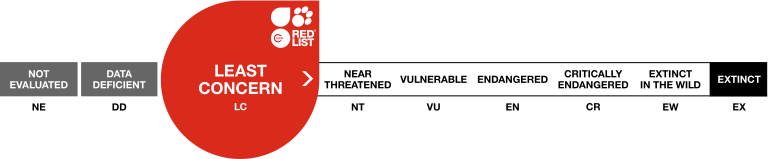
Taxon category: Accepted
Origin: Native
Map of specimen collection localities or observation records for this species in our collections database.
Distribution: A pantropical species, common throughout the transition and humid zone, rarely found in the dry zone, on a wide variety of trees and shrubs including Bursera graveolens, Cinchona pubescens, Zanthoxylum fagara, Psidium galapageium, Erythrina spp., Croton scouleri, and Chiococca alba.
You are welcome to download and use the information found in this page, acknowledging its source.
This page should be cited as follows:
"Galapagos Species Database, Phaeographis intricans", dataZone. Charles Darwin Foundation, https://datazone.darwinfoundation.org/en/checklist/?species=3139. Accessed 3 May 2026.