

Galapagos Species Database
The Galapagos Species Database shares the information about the species from our Natural History Collections.
Tylophoron galapagoense
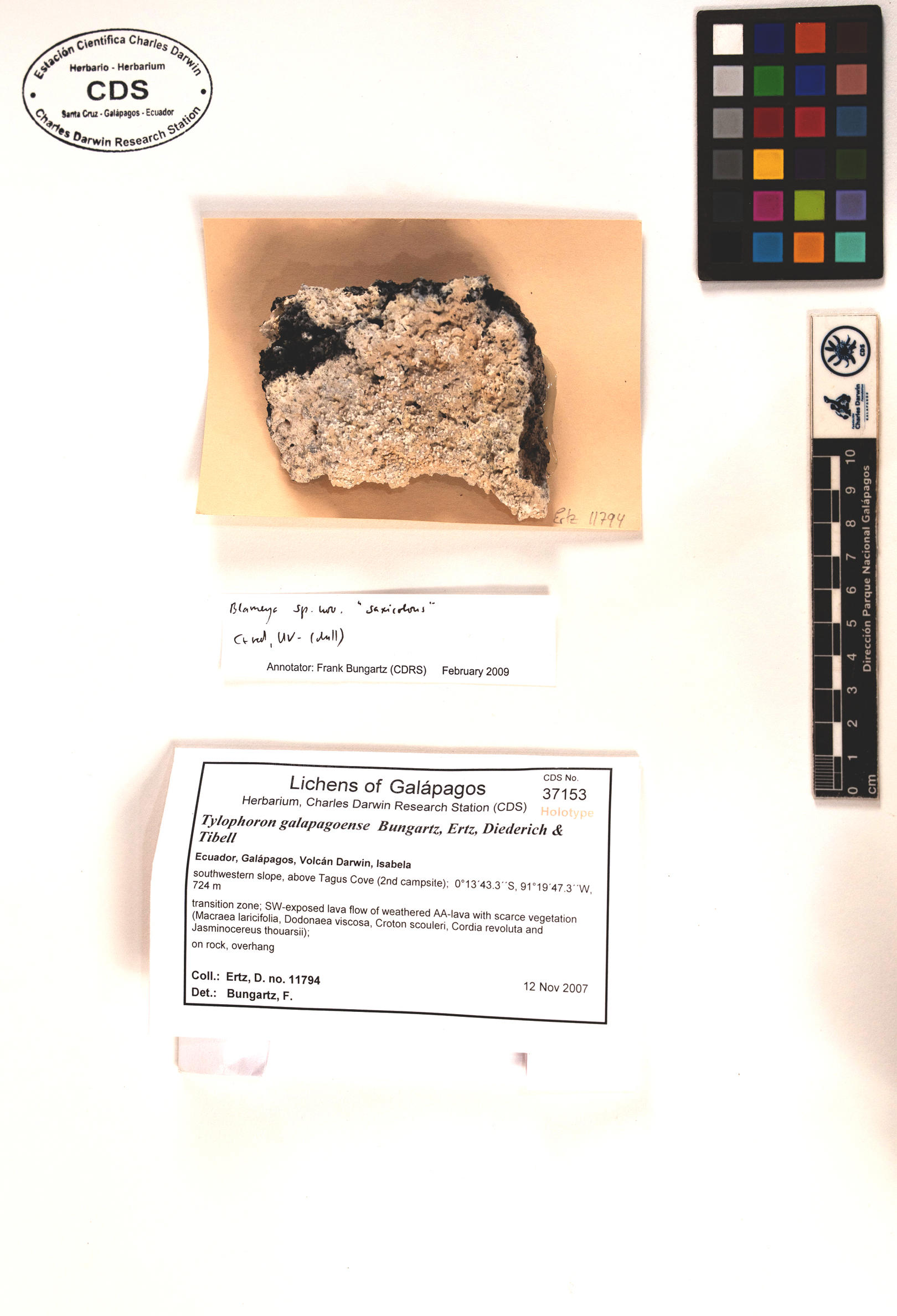
Thallus crustose, superficial, more or less smooth, creamy white to pale brownish, ecorticate, thin, up to 0.5 mm thick; hyphae irregularly branched, hyaline, mainly 2–2.5 µm diam., forming numerous convex to subglobose sporodochia 0.5–1 µm in diam., which are similar in colour, but paler than the thallus. Sporodochial conidia hyaline, smooth to slightly roughened, mostly simple, more rarely 1-septate, with rounded or truncate apices, spherical, ellipsoid or rarely oblong, simple conidia (4.5–)5–6.5(–9) ×(3–)3.5–4.5(–5.5) µm, l/b ratio 1.1–1.9 (n = 60), 1-septate conidia (7–)8–11(–15) × (3–)3–4.5(–6) µm, l/b ratio 2–3.2 (n = 70). Prothallus whitish cream, byssoid, 0.5–1 mm wide. Photobiont Trentepohlia. Ascomata densely covering the thallus of one specimen (Aptroot 65477), but all mazaedia composed of degenerated ascospores and brownish hyphae, no intact ascospores found. Pycnidia unknown. Chemistry. Thallus C+ red, K−, KC+ red, P−, UV−. Sporodochia C+ red, K+ yellow, KC+ red, P−, UV−. TLC: lecanoric acid in all specimens examined. In addition, a pale orange substance in daylight after heating in Ertz 11794.
The species is distinguished from T. hibernicum by a smoother and thicker, more compact thallus, which is always distinctly cream coloured. Furthermore, the C+ red reaction of the thallus is always stronger than in T. hibernicum. In some specimens of T. galapagoense (e.g., Bungartz 8749 and 8750) the majority of conidia are simple (Fig. 3G), in contrast to T. hibernicum in which one-septate conidia usually dominate (Fig. 3F). However, in other specimens of both species, a mixture of one-septate and simple conidia occurs. Overall, even within sporodochia that predominantly produce one-septate conidia, a few simple conidia can typically be found, and vice versa. Because one-septate conidia easily fracture, it is difficult to assess if the formation of simple vs. one-septate ones follows a different conidiogenesis. Specimens that produce mostly simple conidia generally have conidia with a more spherical shape, whereas simple conidia derived secondarily from septate ones that broke apart, are typically more elongate, with an oval to ellipsoid, not spherical shape. Overall we could not find any clear correlation between these differences and a particular species, and the predominance of simple vs. one-septate, spherical vs. elongate conidia may perhaps be related more to environmental factors than to genetic factors.
Domain
Eukaryota
Kingdom
Fungi
Phylum
Ascomycota
Class
Arthoniomycetes
Order
Arthoniales
Family
Arthoniaceae
Genus
Tylophoron
Species
galapagoense
Taxon category: Accepted
Holotype Ertz 11794 (CDS 37153)
Origin: Endemic

Map of specimen collection localities or observation records for this species in our collections database.
You are welcome to download and use the information found in this page, acknowledging its source.
This page should be cited as follows:
"Galapagos Species Database, Tylophoron galapagoense", dataZone. Charles Darwin Foundation, https://datazone.darwinfoundation.org/en/checklist/?species=4505. Accessed 5 November 2026.