

Galapagos Species Database
The Galapagos Species Database shares the information about the species from our Natural History Collections.
Petroselinum crispum
perejil, apio, ligustico peregrino, parsley, garden parsley, rock parsley
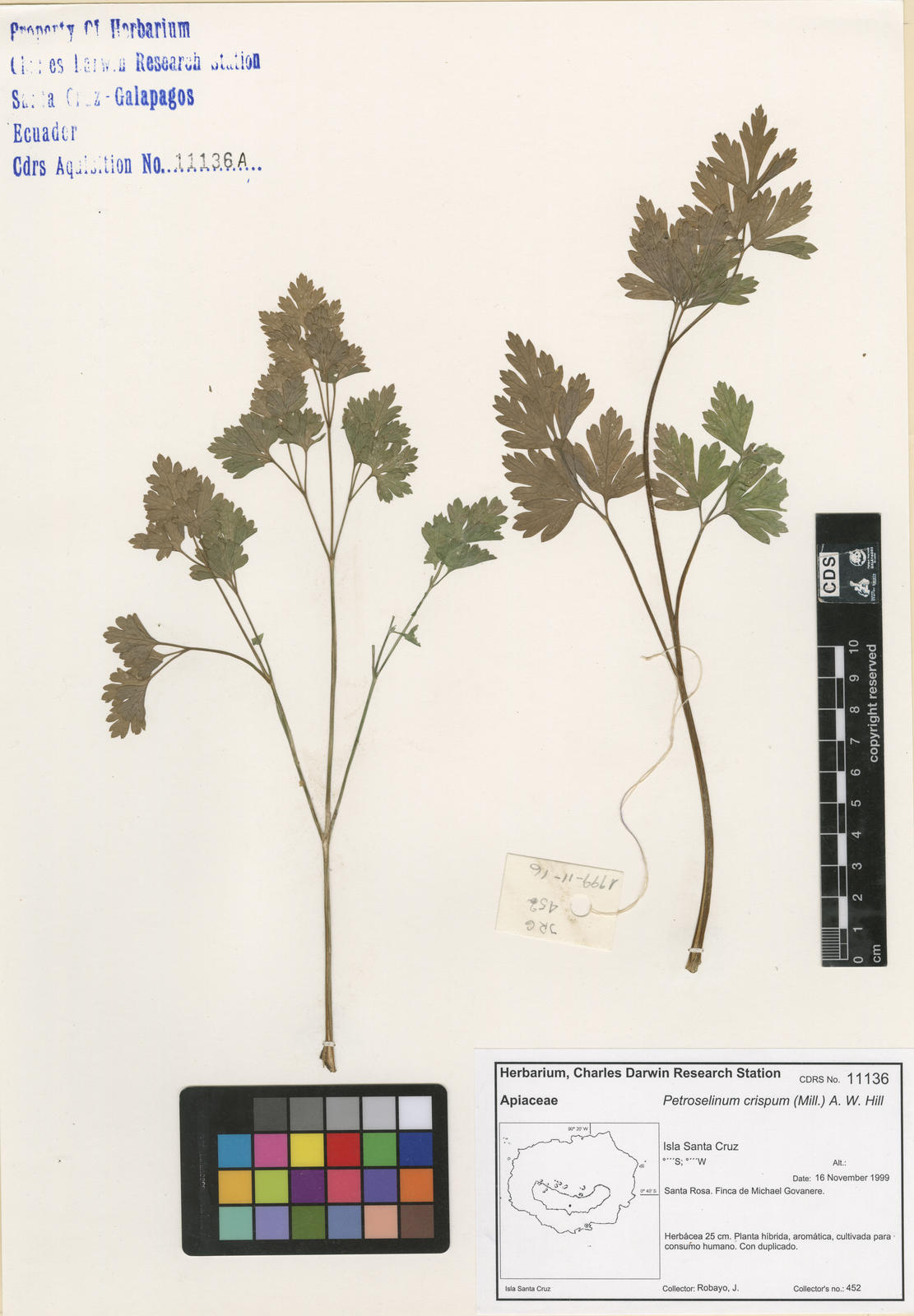
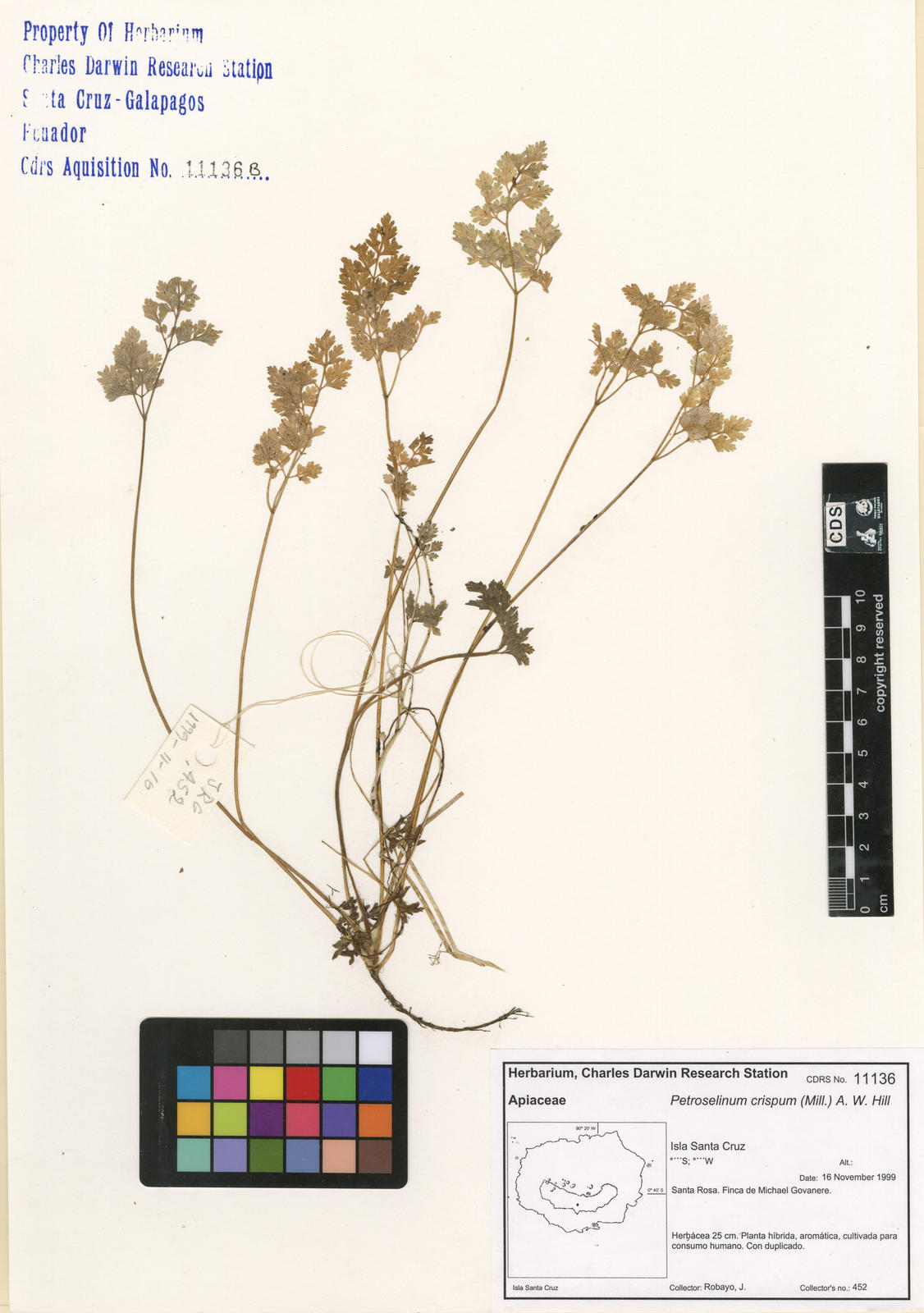
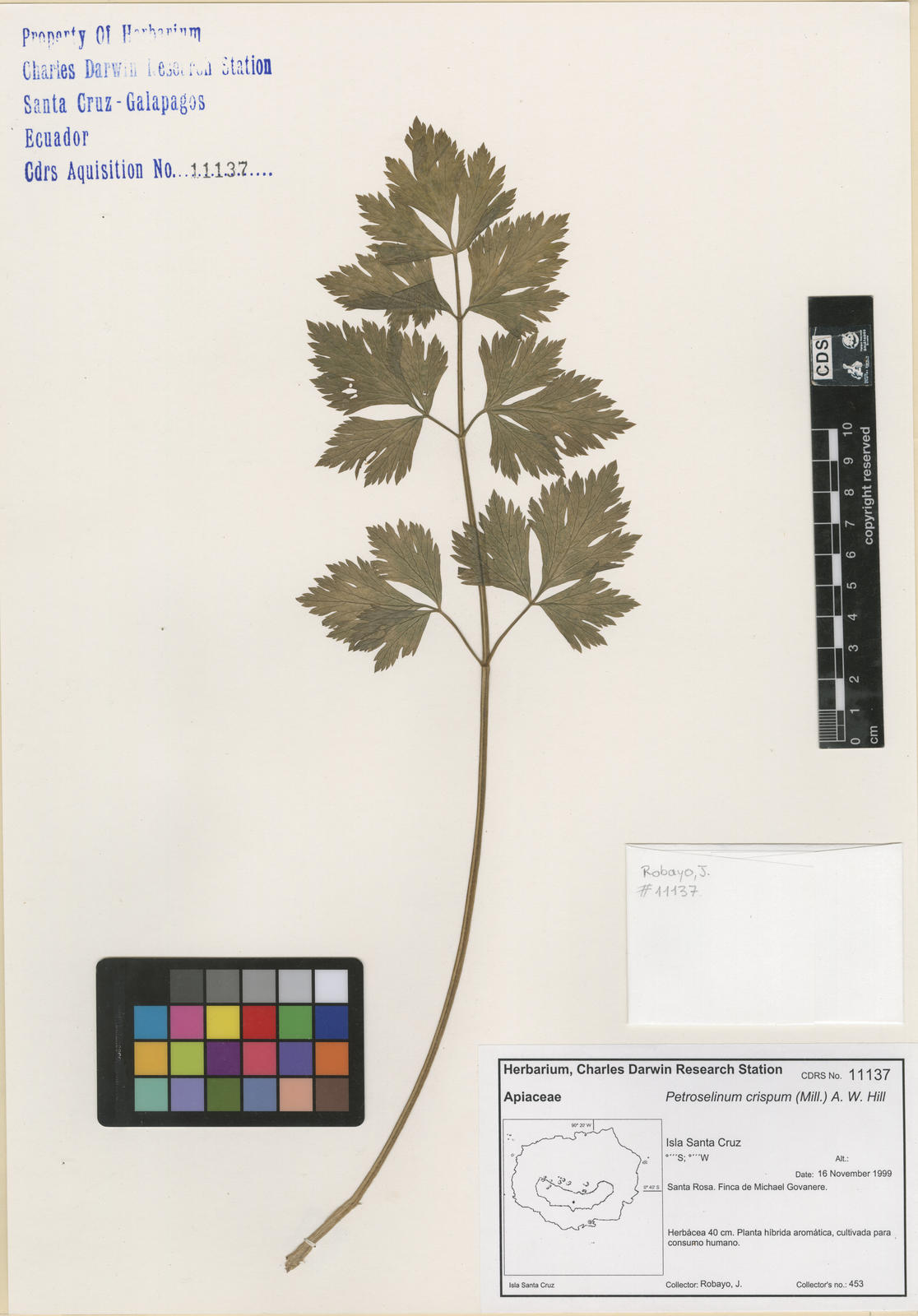
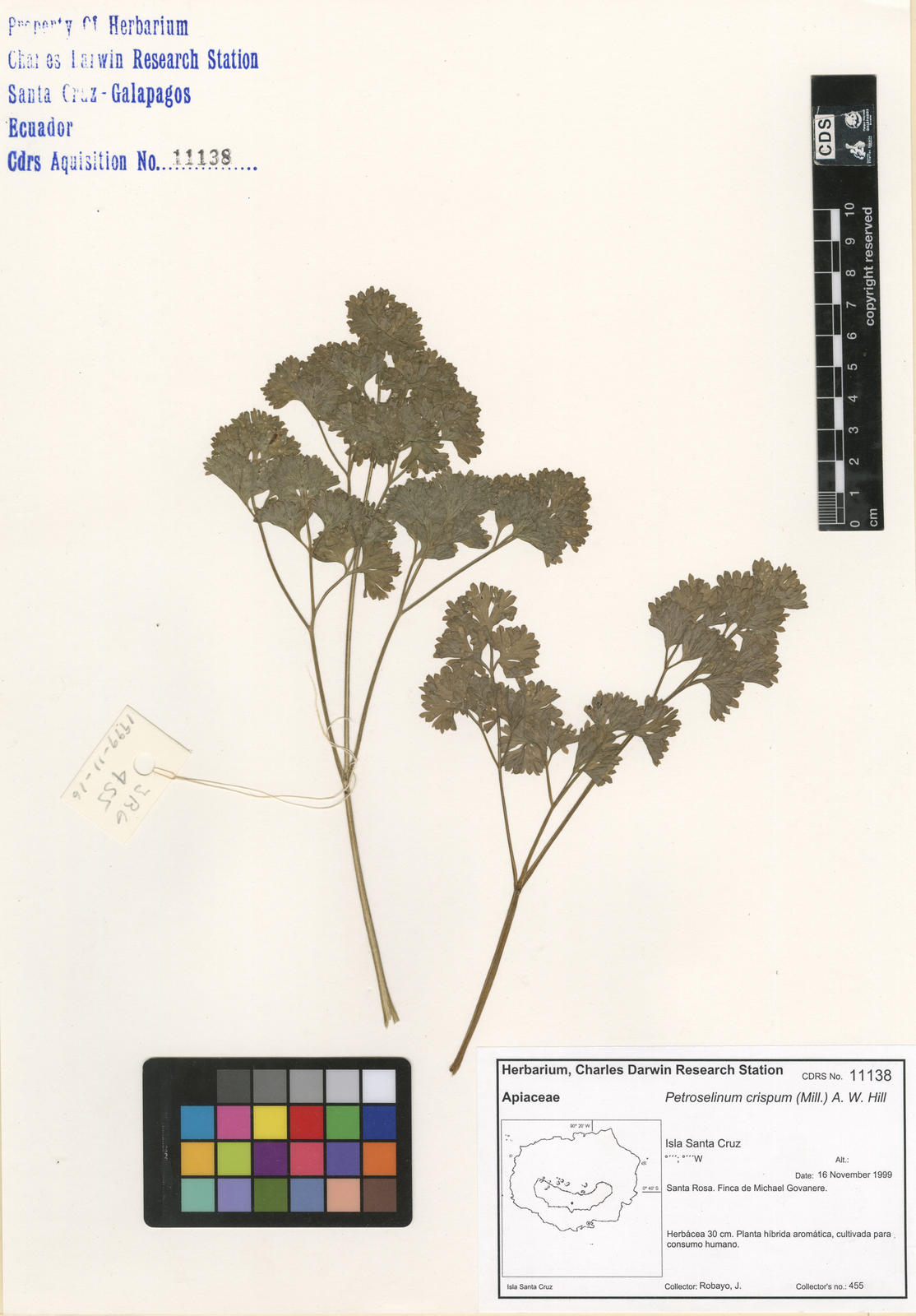
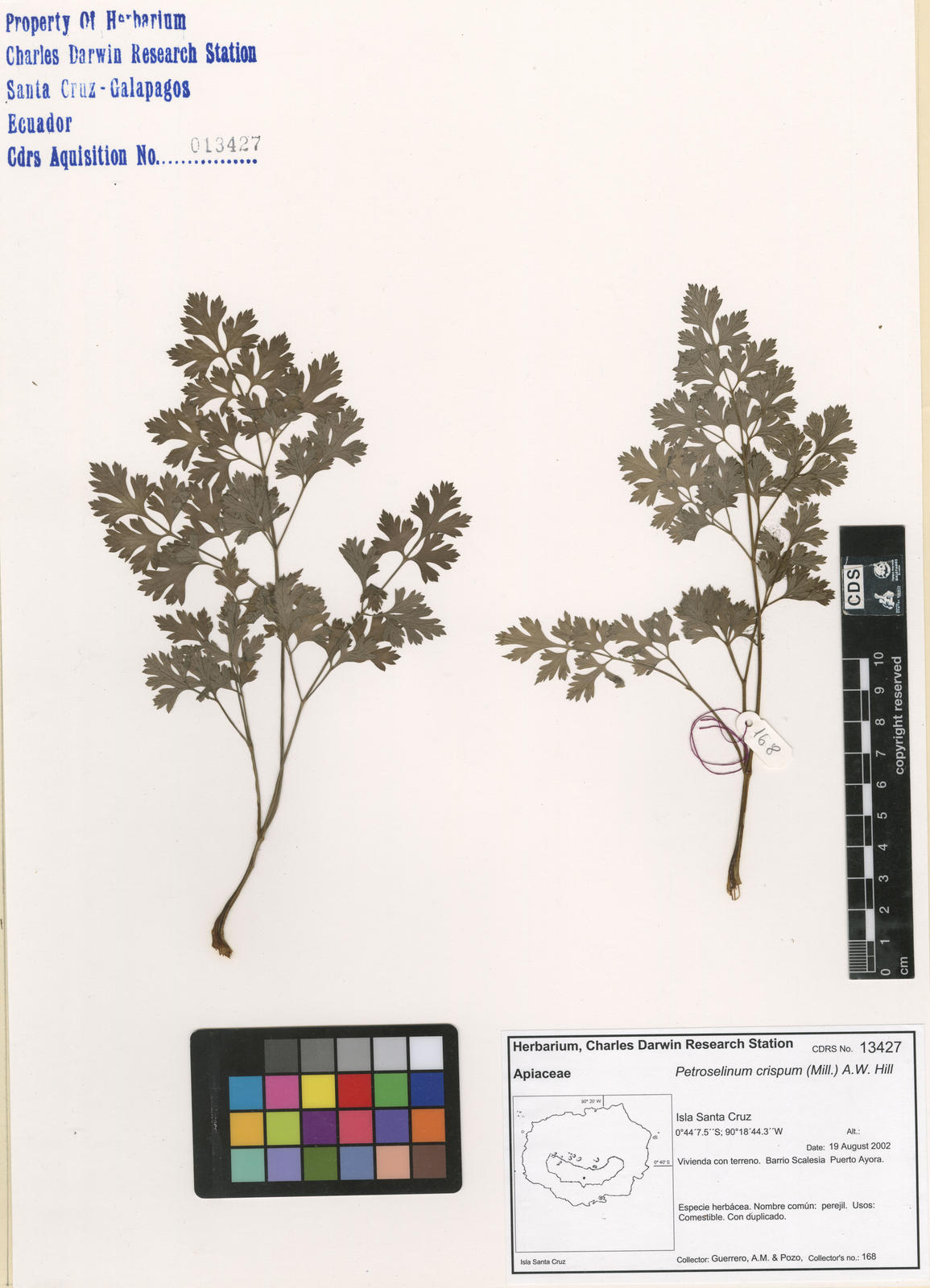
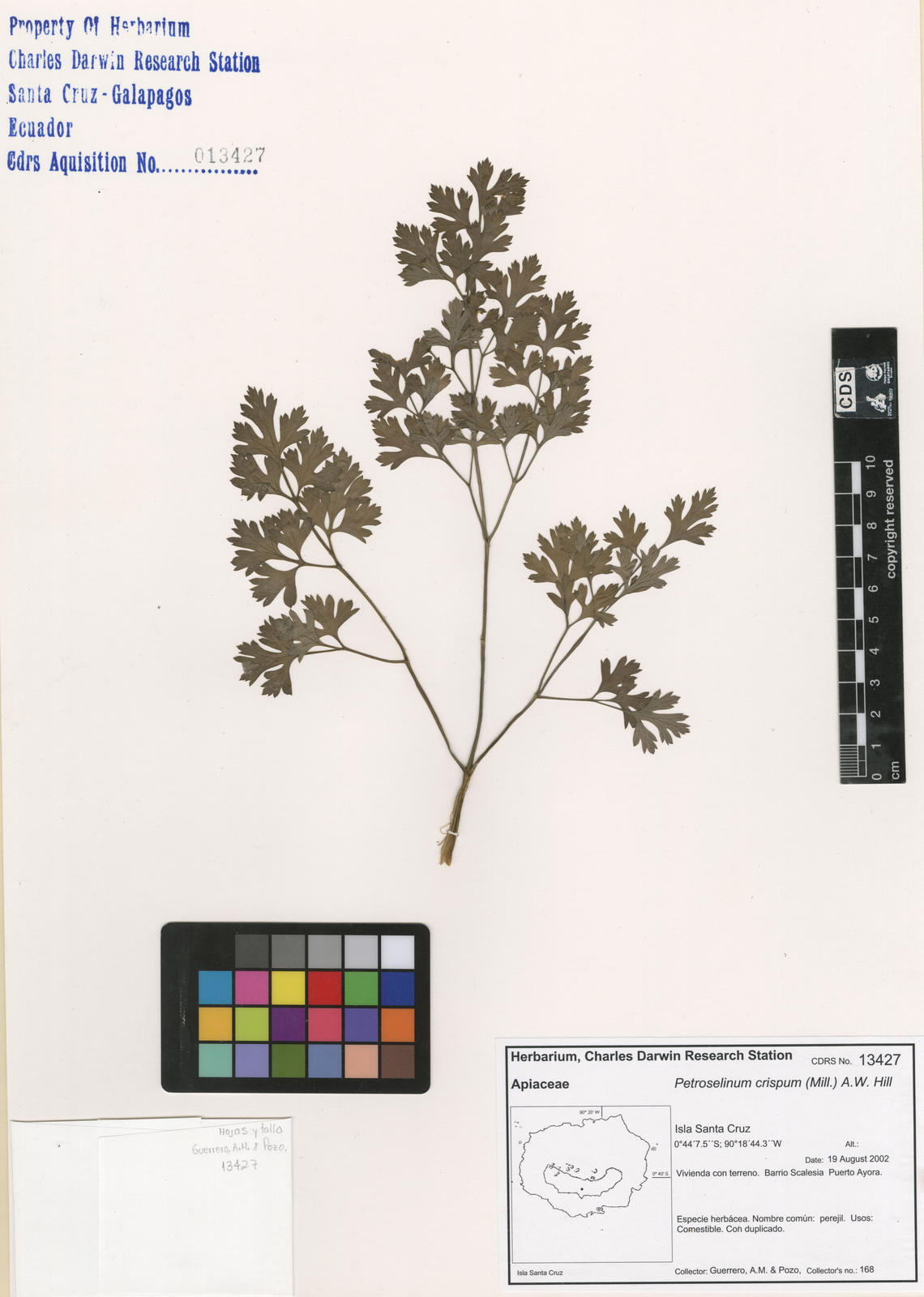
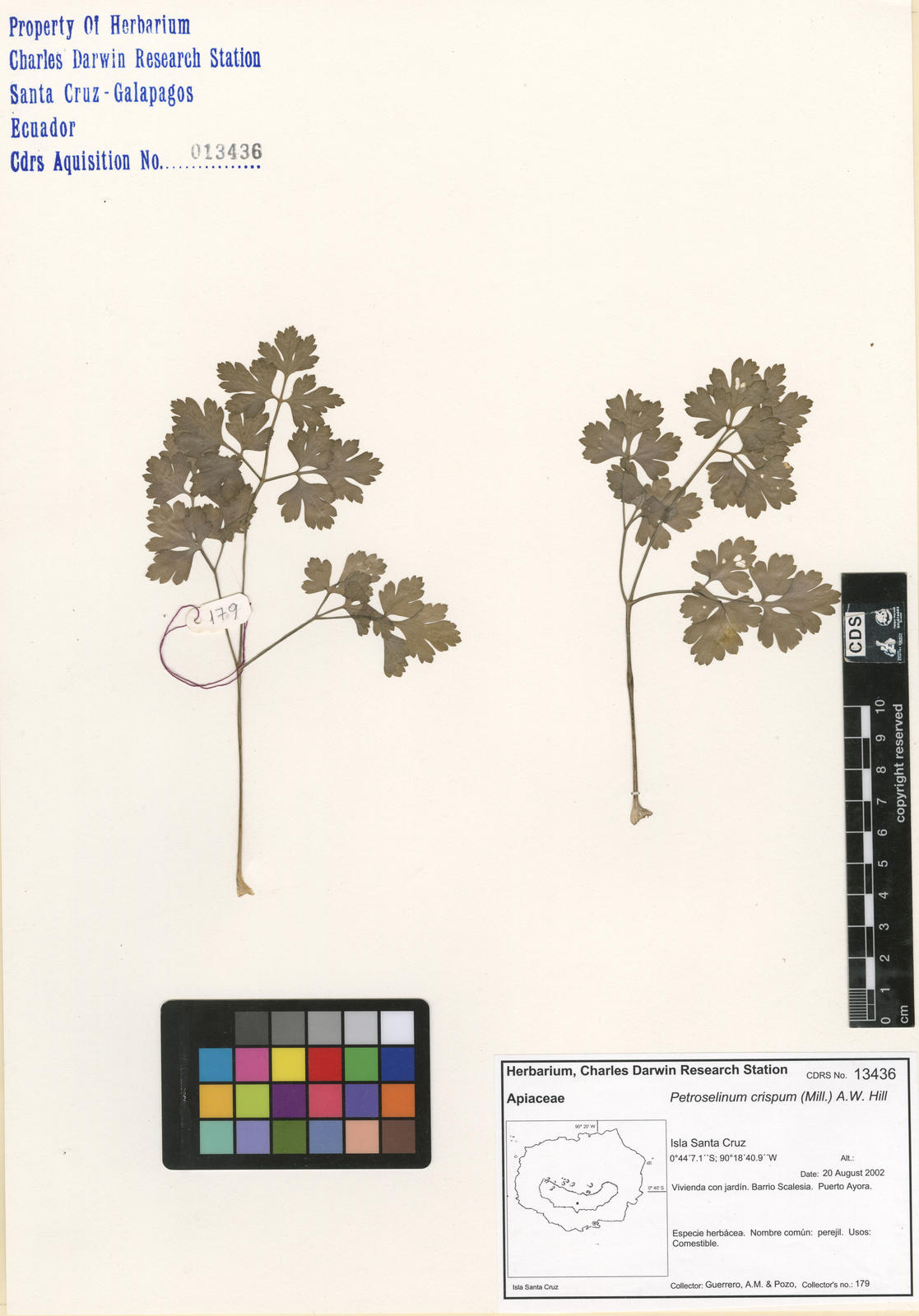
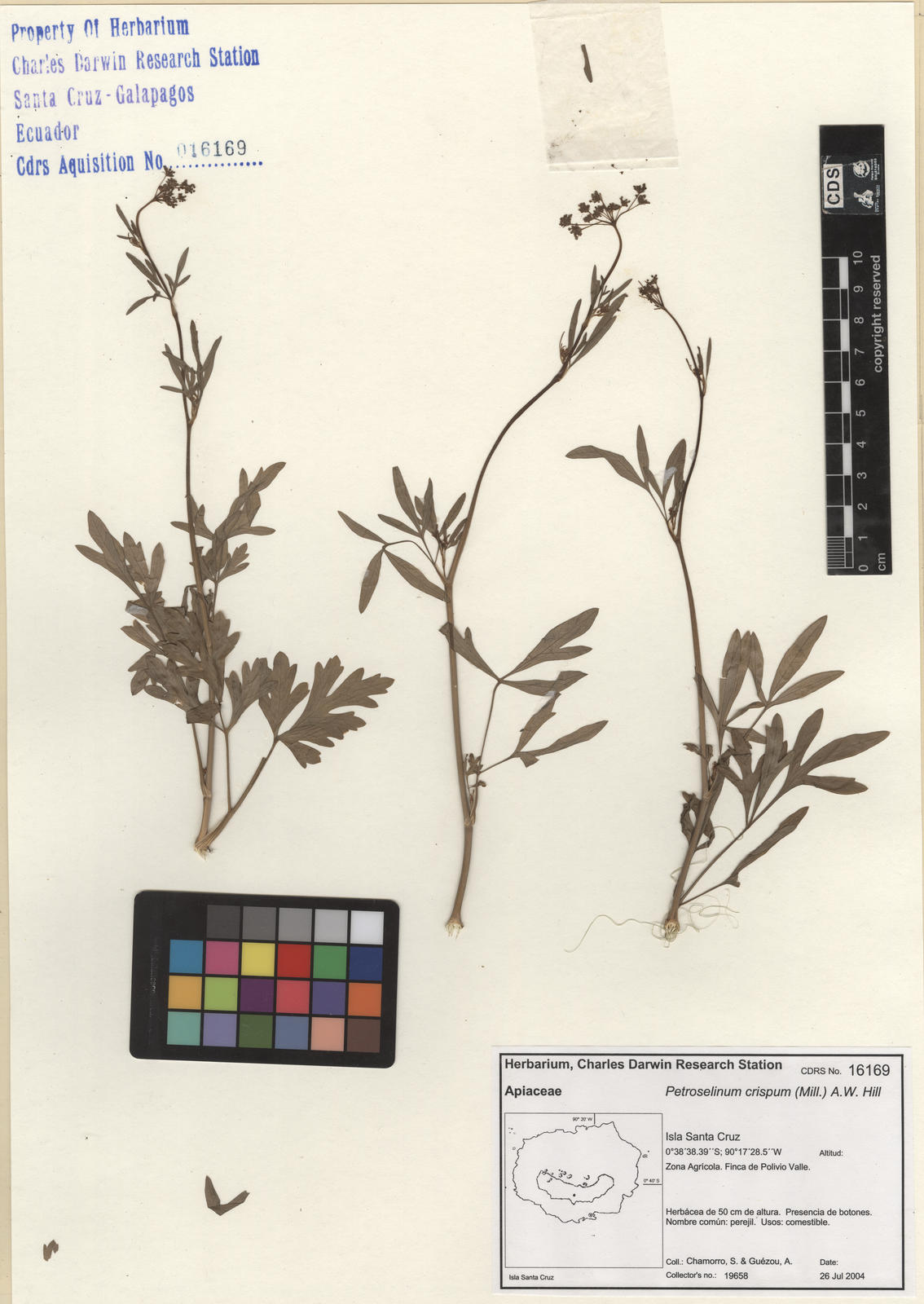
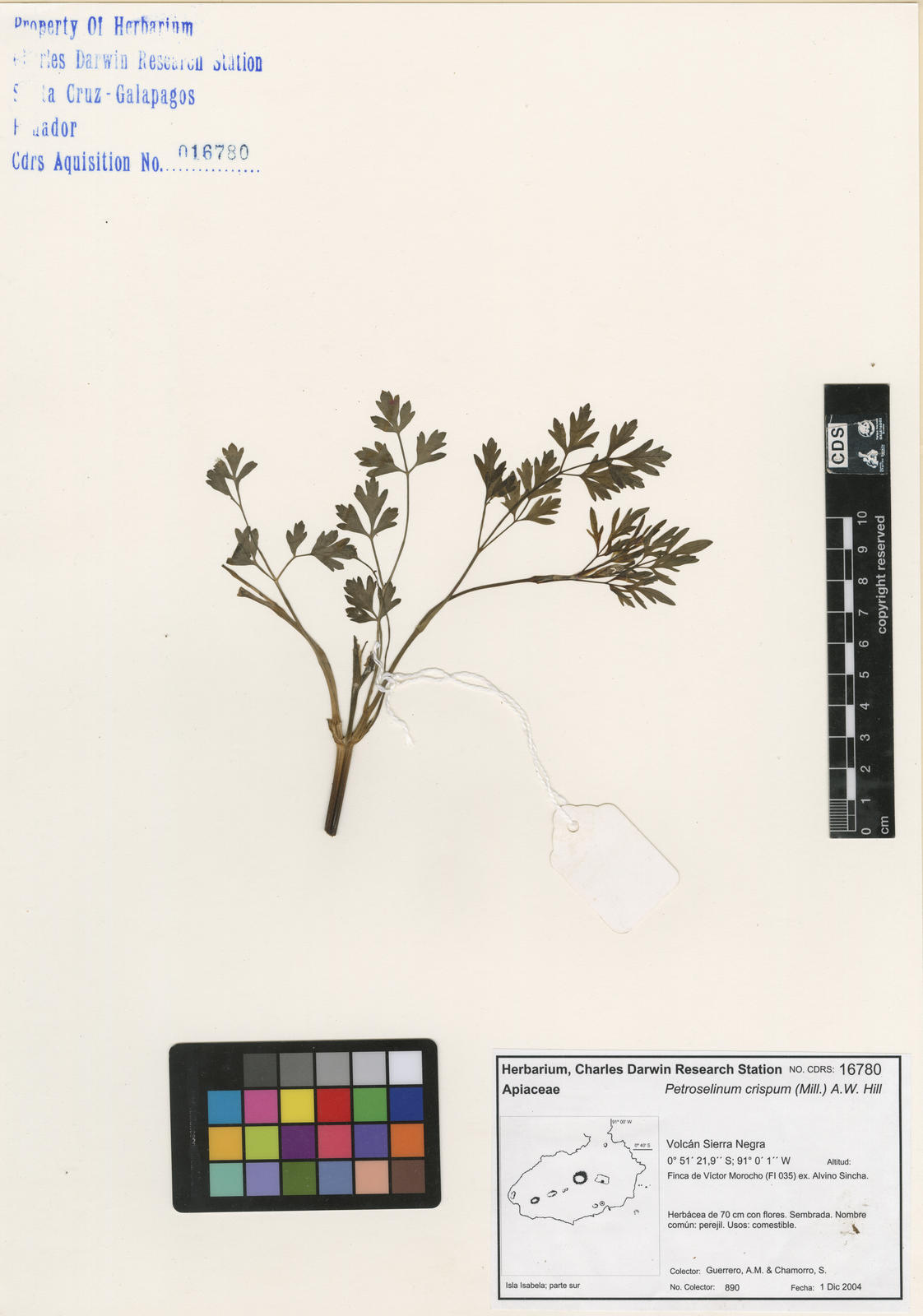
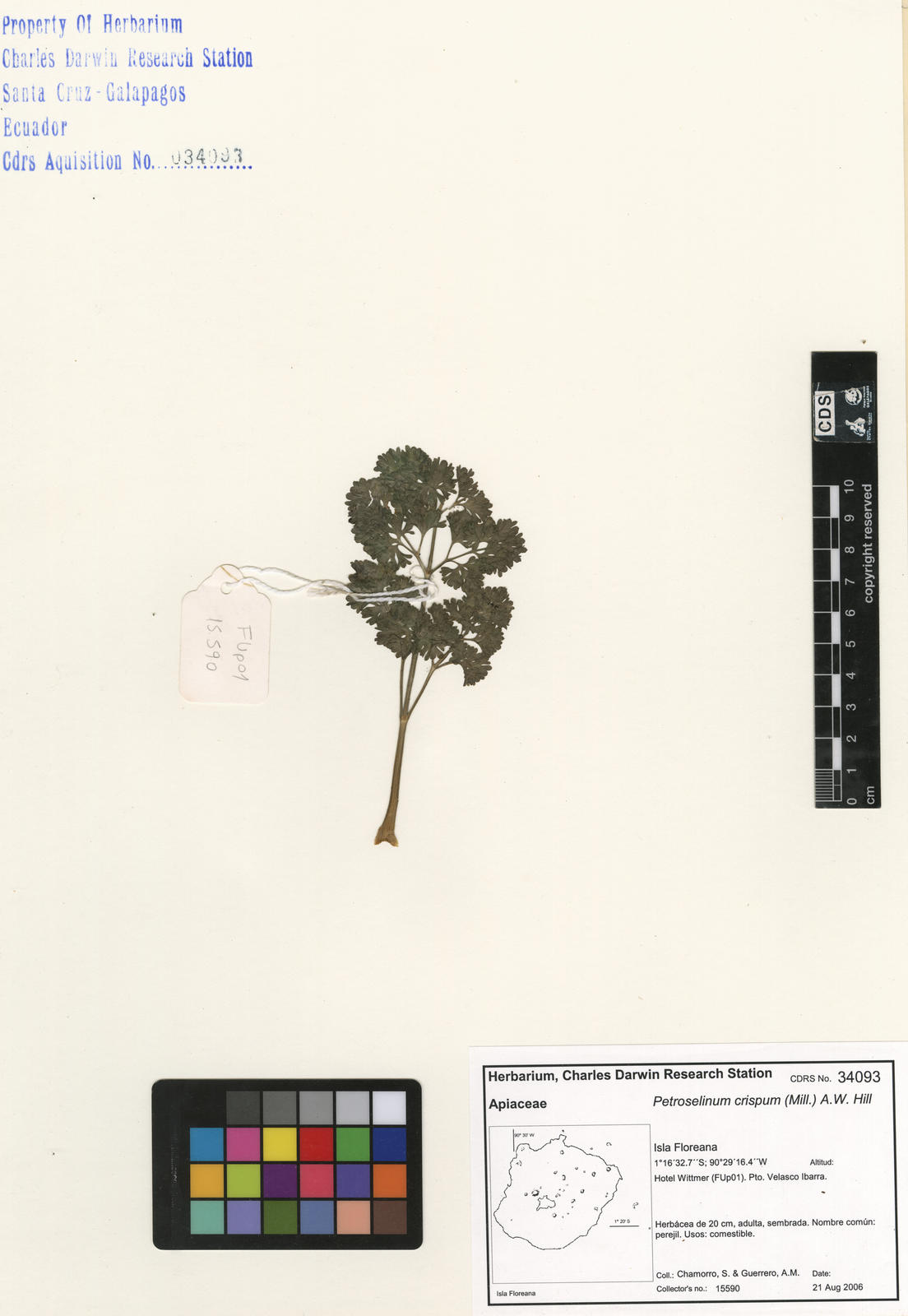
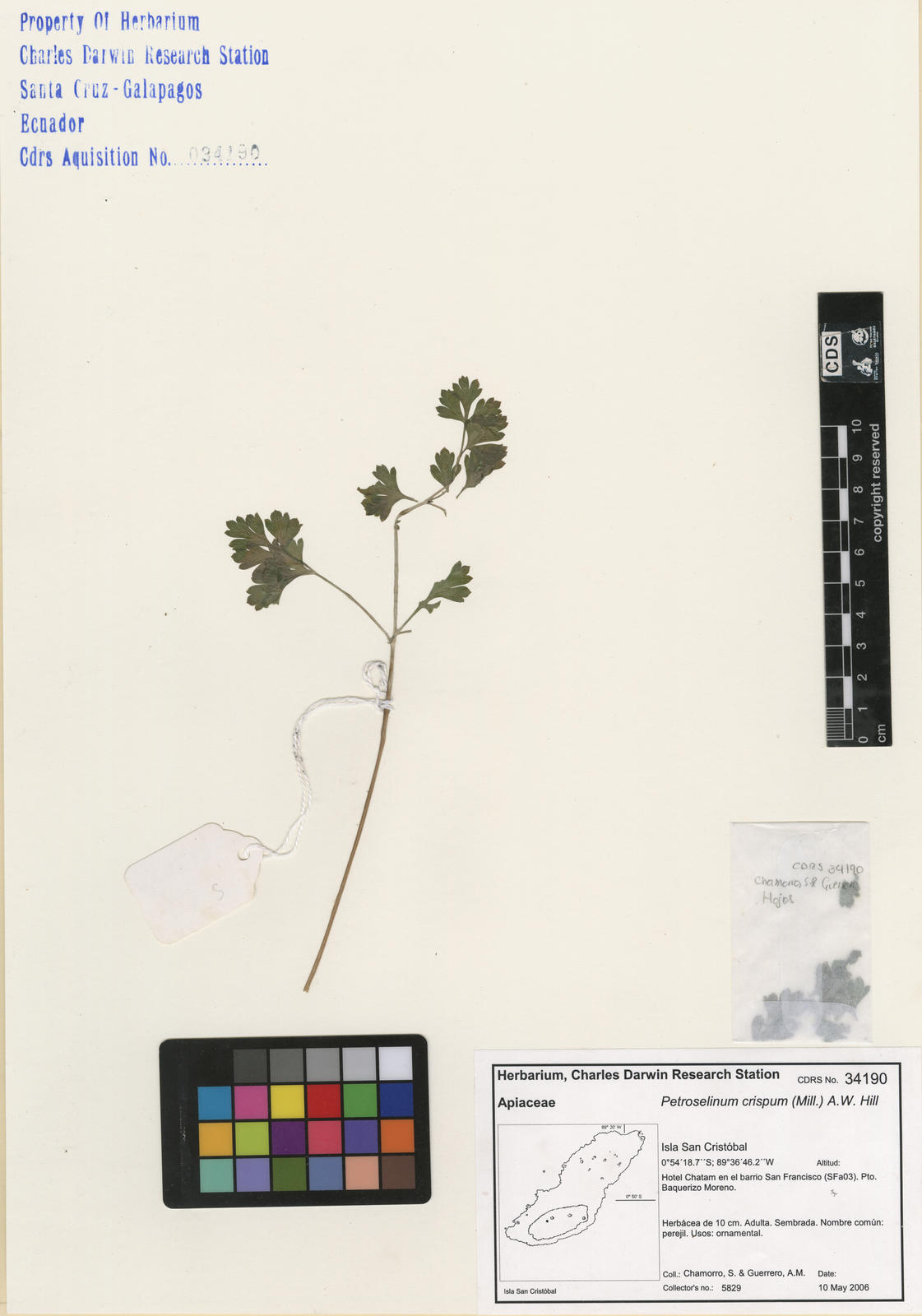
Plant 30–100 cm. Basal leaves long-petiolate, petioles 3–7 cm, narrowly sheathing at base; ultimate segments narrowly elliptic or ovate, 3-parted or deeply toothed, teeth obtuse, white-mucronate, adaxially shiny. Leaves reduced upwards, becoming 3-lobed, segments narrower, lanceolate-linear, entire or 3-lobed, shorter than flowers; umbellules ca. 20-flowered; pedicels 1.5–4.5 mm. Fruit 2–4 × 1.5–3 mm, gray-brown (WFO, 2022).
It is used as a medicine and for food (POWO, 2022).
Domain
Eukaryota
Kingdom
Plantae
Phylum
Magnoliophyta
Class
Magnoliopsida (= Dicotyledoneae)
Order
Apiales
Family
Apiaceae
Genus
Petroselinum
Species
crispum
Taxon category: Accepted
Unresolved nomenclature as of 18-Jul-2011 fide Royal Botanic Gardens, Kew & Missouri Botanical Garden (2010). This binomial combination is cited in Wiggins & Porter (1971) as Petroselinum crispum (Mill.) A W. Hill, Hand-list Herb. Pl. Kew. ed. 3, 122. 1925. In Royal Botanic Gardens, Kew & Missouri Botanical Garden (2010) it is cited as Petroselinum crispum (Mill.) Fuss, Fl. Transsilv. 254 254 1866, which is the current accepted name (POWO, 2023).
Origin: Introduced - established
Year of first record: 1852
Mode of introduction: Intentional
Introduction Pathway: Intentional
Subpathway: Agriculture/Horticulture
Introduced status: Human dependent
Invasive status: Unlikely to become invasive
Map of specimen collection localities or observation records for this species in our collections database.
Distribution: Its native range is NW. Africa, Balkan Peninsula (POWO, 2022).
- Andersson, N.J. (1855) Om Galápagos Öarnes Vegetation. Kongliga Svenska Vetenskaps Akademien Handl., Stockholm: 61-256.
- Chavez, J. (1993) Diagnostico de la Agricultura y la Ganader¡a en la Provincia de Galapagos. Tesis.
- Clavijo, P. Valdebenito, H. & Hurtado, F. (1991) Plantas introducidas en las areas urbanas de las islas Galapagos. Typescript reports in files of Botany Dept.
- Guézou, A. Trueman, M., Buddenhagen, E., Chamorro, S., Guerrero, A.M., Pozo, P., Atkinson, R. (2010) An extensive Alien Plan Inventory from the Inhabited Areas of Galapagos Plos One/ www.plosone.org. Volume 5/ Issue 4/e10276
- Lawesson, J.E. (1987) Plantas exóticas en las Islas Galápagos, un resumen. Memorias. Taller sobre investigación Botánica y manejo en Galápagos. Pg. 17-23.
- Lundh, J.P. (1995) Some additional information and comments on the Annotated Check list of Vascular Plants of the Galapagos Islands by Lawesson, Adsersen and Bentley. Charles Darwin Research Station, unpublished.
- Porter, D.M. (1983) Vascular Plants of the Galapagos: Origins and Dispersal. In: Bowman, R.I., Berson, M. & Leviton, A.E. (eds.): Patterns of evolution in Galápagos organisms. Pacific Division, AAAS, San Francisco, California, p. 33-96.
- Royal Botanic Gardens, Kew (2022) Plants of the world online POWO (2022): Plants of the world online. Published on the Internet; Https://powo.science.kew.org/
- Tropicos.org. (2017) Database of Missouri Botanical Garden. Tropicos.org. Missouri Botanical Garden. 06 Oct 2017 <http://www.tropicos.org
- Wiggins, I.L. Porter, D.M. (1971) Flora of the Galapagos Islands Standford University Press, Stanford.
You are welcome to download and use the information found in this page, acknowledging its source.
This page should be cited as follows:
"Galapagos Species Database, Petroselinum crispum", dataZone. Charles Darwin Foundation, https://datazone.darwinfoundation.org/en/checklist/?species=808. Accessed 31 October 2026.